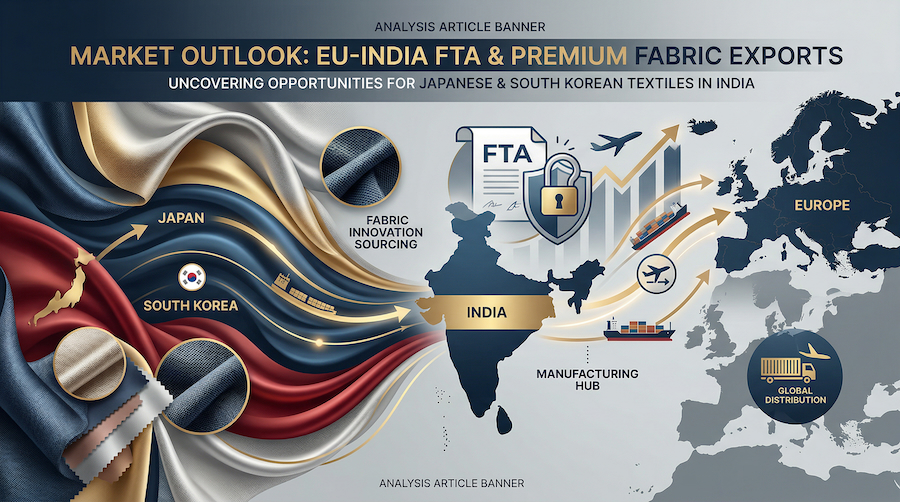
市場調査ブログ Vol.2 / インド × 日本・韓国 生地販売 × EU-India FTA
日本・韓国の生地はインドで売れるか(第2回)
— EU-インドFTAが変えるインドアパレル産業の輸出戦略と、生地サプライヤーへの示唆 —
EU欧州委員会・インド商工省(PIB)・Fibre2Fashion・Business Standard・Textile Excellence・CareEdge Ratings・RFKN Legal・BusinessToday・CNBC・ESCAP ほか各機関公表資料をもとに編集
インドのテキスタイルメーカーと直接会えるビジネスの場
インドトレンドフェア東京
インドのアパレル・縫製事業者のニーズを直接確認できる場です。
🏷 詳細はこちら →
2026年1月27日、インドとEU(欧州連合)は「すべての取引の母」と称される包括的自由貿易協定(FTA)の交渉妥結を発表した。インドのアパレル・縫製事業者がEUに輸出する際の関税が最大12%から原則ゼロになるという変化は、日本・韓国の生地サプライヤーにとっても重要な示唆を持つ。インドの縫製工場に生地を売るということが「EU向け製品を間接的に売る」ことと直結するからだ。本稿では、確認済みのデータと引用文献のみをもとに、この構造変化を整理する。推論は含まない。
一言でまとめると:EUがインドのアパレル関税をゼロにしたことで、インドの縫製・アパレル事業者はEUへの輸出拡大を目指して設備投資・品質投資を加速させる。そのためのインプット(生地・素材)の調達ニーズが高まる——これが、日本・韓国の生地サプライヤーにとっての機会である。
✏️ 編集後記
本稿は前回記事「日本・韓国の生地はインドで売れるか(第1回)」の続編として執筆した。EU-インドFTAは2026年1月27日の交渉妥結後、批准・発効まで少なくとも1年程度かかる見込みと報道されている(インド商工大臣ピユシュ・ゴヤル氏、2026年1月27日記者会見)。本稿は確認済みデータのみを掲載しており、推論・予測的解釈は含まない。
🇮🇳🇯🇵 Bharat Tex 2026 公式サイト →
この記事の内容
① EU-インドFTAとは何か
② インド繊維産業への関税メリット
③ 輸出拡大の数値予測
④ EU側の非関税要件(サステナビリティ等)
⑤ 日本・韓国サプライヤーへの示唆
⑥ 留意点・前提条件
① EU-インドFTA とは何か——交渉妥結までの経緯と主な内容
EU(欧州連合)とインドは2007年6月にFTA交渉を開始したが、2013年に停滞。2021年5月に再開し、2026年1月27日にニューデリーで開催された第16回EU-インド首脳会議において、交渉妥結が発表された。欧州委員会のウルズラ・フォン・デア・ライエン委員長はこれを「すべての取引の母(mother of all deals)」と称した。
EUは関税ラインの約97%・EU輸出額の99.5%以上を対象に関税を撤廃または削減することを約束。インドは関税ラインの約92.1%・輸出額の97.5%を対象に自由化する。2024年の物品貿易総額は1,200億ユーロ(約20兆円)に達しており、EUはインド最大の貿易相手国となっている。
出典:EU欧州委員会「EU-India Free Trade Agreement: Chapter-by-Chapter Summary」(2026年2月2日)
重要な前提:2026年1月27日時点での「交渉妥結」であり、発効には欧州議会・EU理事会・インド議会の批准が必要。インド商工大臣ゴヤル氏は2026年中の発効を目指すと発言。ただし、GTRI(Global Trade Research Initiative)は発効まで「少なくとも1年」との見方を示している(EU-India Trade Council、2026年1月23日)。
② インド繊維・アパレル産業への関税メリット——数字で見る変化
FTA前、インドのアパレル・繊維製品はEUへの輸出に際して最大12%のMFN(最恵国)関税が課せられていた。一方、バングラデシュは「Everything But Arms(EBA)」フレームワークにより無関税アクセス、ベトナム・パキスタン・カンボジアも優遇制度で有利な立場にあった。この結果、インドはEUのテキスタイル輸入のわずか約5%(約72億ドル)しかシェアを持てていなかった。
出典:Textile Excellence「EU-India FTA: Impact On India’s Textile & Apparel Exports To EU」(2026年1月26日);Business Standard「India-EU FTA: A transformational opportunity for India’s textiles」(2026年2月2日)
| 項目 |
FTA前 |
FTA後(発効時) |
出典 |
| アパレル・衣料品の関税 |
9.6〜12%(MFN) |
ゼロ(発効時即時) |
Textile Excellence (2026年1月) |
| 繊維製品全般 |
8〜12%(MFN) |
全関税ラインでゼロ |
PIB(インド商工省)(2026年1月) |
| EUへの繊維輸出額(2024-25年度) |
約72〜80億ドル |
3年以内に20〜25%増が見込まれる(業界予測) |
Fibre2Fashion (2026年1月) |
| EUのテキスタイル輸入市場規模(2024年) |
2,635億ドル(インドのシェア約5%) |
PIB (2026年1月) |
中国との比較:EU市場でのアパレル輸入において、中国は現在約30%のシェアを持つ最大供給国だが、FTA締結後のインドは「中国に対して12%の関税優位」を持つ見通し。CareEdge Ratingsのレポートは「中国+1戦略を採用するグローバルブランドにとって、インドの競争力が一段と高まる」と分析している(NewKerala、2026年1月27日)。
③ 輸出拡大の数値予測——確認済みの数値のみ
RMG輸出増加予測(発効後3年)
40〜45億ドル増
CareEdge Ratings(2026年1月)
EUでのインドシェア予測
5% → 8〜9%
CareEdge Ratings(2026年1月)
インド繊維輸出の長期目標
1,000億ドル
2030年目標(Business Standard、2026年2月)
Textile Excellenceは「タリフ撤廃によりインドのアパレル輸出はEUへ3年以内に20〜25%増加する見込み。バングラデシュ、ベトナム、カンボジアとの価格競争条件が均等化されることで、付加価値の高いカテゴリー・サステナブル製品へのソーシング転換が加速する」と分析している。
出典:Textile Excellence「EU-India FTA: Impact On India’s Textile & Apparel Exports To EU」(2026年1月26日)
製品別内訳:インドのEU向け繊維輸出のうちRMG(既製服)が約60%、綿製品が17%、化合繊が続く。ホームテキスタイル(タオル・ベッドリネン等)は2024年度に15.4億ドル。主要輸出先はドイツ(18.7%)・オランダ(15.8%)・スペイン(13%)・フランス(12.8%)・イタリア(10.4%)の5か国で70%を占める(Business Standard、2026年2月2日;PIB、2026年1月27日)。
④ EU側の非関税要件——関税ゼロだけでは参入できない
Keypoint Intelligenceは「関税撤廃がコスト競争力を高める一方、長期的な市場シェアは持続可能な生産、デジタル印刷精度、ターンアラウンドサイクルの速さを求めるEU側のニーズへの対応力によって決まる」と指摘している(2026年1月30日)。確認済みの主な要件は以下のとおり。
🌿 原産地規則(Rules of Origin)
繊維・アパレルには「工程ルール(process rule)」または「関税分類変更(CTC)ルール」が適用される。第三国(例:日本・韓国)で生産した生地をインドで縫製しただけでは「インド原産」と認められない可能性がある。インド国内での実質的加工・変換が必要。
出典:インド商工省「India-EU FTA FAQ」(PIB、2026年1月29日)
♻️ ESPR・デジタルプロダクトパスポート
EU「エコデザイン持続可能製品規則(ESPR)」はテキスタイルを含む製品のデジタルプロダクトパスポート(DPP)義務化を進める。サプライチェーンの透明性・トレーサビリティが要求される。
出典:IMT Centre for Distance Learning「India-EU FTA 2026」;EU-India Market Access「eeuropa.org」
📋 CSDDD(サステナビリティデューデリジェンス)
2027年施行予定のEU指令により、企業はサプライチェーン全体で人権・環境リスクを監査する義務を負う。インドメーカーへのコンプライアンス要求が増すと見られる。
出典:drishtiias.com「India-EU FTA」(2026年1月28日)
⚗️ REACH規制・化学物質管理
EU REACH規制(化学物質の登録・評価・認可)はテキスタイル・染料を含む幅広い製品に適用される。生地に含まれる化学物質のコンプライアンスが求められる。
出典:IMT Centre for Distance Learning「India-EU FTA 2026」
RFKN Legalは「EU規制基準(化学物質・ラベリング・サステナビリティ・労働慣行)は厳格であり、インド輸出業者がこれらの要件を満たすための法的助言を得ることが重要」と指摘。また「原産地・コンプライアンスに関する紛争を回避するため、適正な文書作成・認証管理が不可欠」と述べている(RFKN Legal、2026年1月31日)。
⑤ 日本・韓国の生地サプライヤーへの示唆——確認済みの事実から導かれる構造
以下の各点は、本稿が引用する一次資料の内容から構造的に確認できる事実である。推論は含まない。
事実①
インドの縫製工場はEU向け輸出拡大に向けた品質・設備投資を行う誘因が生まれた
Fibre2Fashionは「EU市場へのアクセス改善により、インドメーカーはテクニカル生地・高機能素材など付加価値の高いセグメントへの投資を拡大し、欧州の品質・サステナビリティ基準を満たすための設備投資が増える見込み」と報告している。
出典:Fibre2Fashion「India-EU FTA could reshape apparel and textile trade dynamics」(2026年1月27日)
事実②
EU市場は「機能性・付加価値生地」を明確に求めている
Global Textile Timesは「EUのアパレルバイヤーはコスト削減だけでなく、品質の安定・設計主導型製品・短サイクルでの供給を重視しており、インドへのソーシングシフトはより高付加価値な製品カテゴリーでの取引に向かう」と分析している。
出典:Global Textile Times「EU-India FTA: What It Means for European Textile Industry」(2026年1月28日)
事実③
インドのMMF(化合繊)セクターはEU向けに最も成長余地が大きいカテゴリー
Fibre2Fashionは「EUのアパレル需要の多くがMMFおよびブレンド素材で占められる中、インドのサラット(Surat)などのMMFハブはEU向けに輸出を拡大する見通し。化学繊維分野での統合的な生地・縫製ソリューション提供が可能になる」と述べている。
出典:Fibre2Fashion「India-EU FTA could reshape apparel and textile trade dynamics」(2026年1月27日);EU欧州委員会「Chapter-by-Chapter Summary」(2026年2月2日)
事実④
欧州系テキスタイル機械・素材企業がインドの設備投資から恩恵を受けると予測
RFKN Legalは「EUへの輸出が増えるにつれ、インドメーカーは高度な技術・特殊生地・先進染色・仕上げプロセスに投資する。欧州のテキスタイル機械・化学品・技術的インプットのサプライヤーがこのアップグレードプロセスから新たなビジネス機会を得る」と述べている。
出典:RFKN Legal「Textiles under the India-EU FTA: What It Means for Indian and European Companies」(2026年1月31日)
📊 構造のまとめ——生地サプライヤーが確認できること
EUがインドのアパレル関税をゼロにした結果、インドの縫製・アパレル事業者はEU向け輸出拡大を目指す明確な誘因を持つ。その際にEU側が求める基準(機能性・サステナビリティ・トレーサビリティ)に対応するため、インドメーカーは生地・素材の品質レベルを引き上げる投資を行う。
日本・韓国の生地サプライヤーが「EU規格に適合したインド縫製品のためのインプット素材サプライヤー」として参入する余地はこの点に存在する。ただし原産地規則への対応(実質的変換)と、EU非関税要件(REACH・サステナビリティ)への対応が前提条件となる。
[simple-author-box]
インドのアパレル・縫製メーカーと直接会う——メーカーとのバイヤーとの商談
インドトレンドフェア東京
生地ニーズ・用途・品質基準・価格帯——インドの縫製メーカーに直接確認できる場です。
🏷 インドトレンドフェア東京 詳細と参加登録
主催:NPO法人日印国際産業振興協会(JIIPA) | india-trend-fair.jp
インドトレンドフェア東京を主催するJIIPAは、日本とインドの経済・貿易・産業連携を促進するNPOです(東京都認定)。東京・ニューデリー・ムンバイにオフィスを持ちます。
⑥ 留意点・前提条件
- EU-インドFTAは2026年1月27日に交渉妥結が発表されたが、発効には欧州議会・EU理事会・インド議会の批准が必要。インド商工大臣ゴヤル氏は2026年中の発効を目指すと発言(CNBC、2026年1月27日)
- 原産地規則により、日本・韓国産の生地をインドで縫製するだけでは「インド原産」と認められない可能性がある。実質的変換(substantial transformation)の確認が必要(PIB FAQ、2026年1月29日)
- CBAM(炭素国境調整メカニズム)は現時点では鉄鋼・アルミ等が対象でテキスタイルは含まれないが、将来的な対象拡大の可能性はKPMG等が指摘している(Fibre2Fashion、2026年)
- EUのGSP「卒業」により、インドの一部輸出品目は2026〜2028年の期間、関税優遇の一時停止が生じている。FTA発効前の移行期間中は対応が必要(EU-India Trade Council、2026年1月23日)
- 業界予測値(輸出額増加率等)は各機関の推計であり、確約ではない
Market Research Blog Vol.2 / India × Japan & Korea Fabric Sales × EU-India FTA
Can Japanese & Korean Fabrics Sell in India? (Part 2)
— How the EU-India FTA Changes India’s Apparel Export Strategy and What It Means for Fabric Suppliers —
Compiled from published data by the European Commission, India Ministry of Commerce (PIB), Fibre2Fashion, Business Standard, Textile Excellence, CareEdge Ratings, RFKN Legal, BusinessToday, CNBC, ESCAP, and others.
Meet Indian Textile Manufacturers Directly
India Trend Fair Tokyo
Verify fabric needs, quality standards, and sourcing preferences directly with Indian apparel & garment manufacturers.
🏷 Details →
On January 27, 2026, India and the European Union announced the conclusion of negotiations for a comprehensive Free Trade Agreement (FTA)—described by both sides as the “mother of all deals.” The agreement’s most significant provision for the textile sector is the elimination of up to 12% import duties on Indian apparel and textile exports to the EU, effective upon entry into force. This structural shift carries direct implications for Japanese and Korean fabric suppliers: selling fabrics to Indian garment factories becomes equivalent to indirectly supplying into the EU market.
In short: With the EU eliminating tariffs on Indian apparel, Indian garment and apparel manufacturers now have a strong incentive to invest in quality upgrades and capacity expansion. This increases demand for premium input materials—fabrics—which creates an opportunity for Japanese and Korean fabric suppliers.
✏️ Editor’s Note
This article is a follow-up to our first piece, “Can Japanese & Korean Fabrics Sell in India? (Part 1).” The EU-India FTA was announced as a political milestone on January 27, 2026. Entry into force requires ratification by the European Parliament, EU Council, and Indian Parliament—a process expected to take at least one year (India Commerce Minister Piyush Goyal, press conference, January 27, 2026). This article contains only confirmed data and no inference or speculation.
🇮🇳🇯🇵 Bharat Tex 2026 Official Site →
Contents
① What Is the EU-India FTA?
② Tariff Benefits for India’s Textile Industry
③ Export Growth Forecasts
④ EU Non-Tariff Requirements
⑤ Implications for Japan & Korea
⑥ Key Caveats
① What Is the EU-India FTA? — Background and Key Provisions
EU-India FTA negotiations opened in June 2007, stalled in 2013, restarted in May 2021, and were concluded at the 16th EU-India Summit in New Delhi on January 27, 2026. European Commission President Ursula von der Leyen called it the “mother of all deals.”
The EU has committed to eliminating tariffs on approximately 97% of tariff lines covering over 99.5% of Indian export value. India has committed to liberalising approximately 92.1% of tariff lines covering 97.5% of EU export value. Bilateral goods trade reached €120 billion in 2024, with the EU as India’s largest trading partner.
Source: European Commission “EU-India Free Trade Agreement: Chapter-by-Chapter Summary” (February 2, 2026)
Key caveat: The January 27, 2026 announcement is a political milestone—”negotiations concluded.” Entry into force requires ratification by the European Parliament, EU Council, and Indian Parliament. India’s Commerce Minister Goyal stated at a press conference that he expects the deal to enter into force in 2026. However, GTRI (Global Trade Research Initiative) indicates “at least one year” before implementation (EU-India Trade Council, January 23, 2026).
② Tariff Benefits for India’s Textile and Apparel Sector
Before the FTA, Indian apparel and textile exports to the EU faced MFN tariffs of up to 12%. Meanwhile, Bangladesh had zero-duty access under the “Everything But Arms (EBA)” framework, while Vietnam, Pakistan, and Cambodia also benefited from preferential arrangements. As a result, India held only about 5% of the EU’s textile import market (approximately $7.2 billion).
Sources: Textile Excellence “EU-India FTA: Impact On India’s Textile & Apparel Exports To EU” (January 26, 2026); Business Standard “India-EU FTA: A transformational opportunity for India’s textiles” (February 2, 2026)
| Item |
Before FTA |
After FTA (upon entry into force) |
Source |
| Apparel & clothing tariffs |
9.6–12% (MFN) |
Zero (immediate on entry into force) |
Textile Excellence (Jan 2026) |
| Textile products overall |
8–12% (MFN) |
Zero across all tariff lines |
PIB – India Ministry of Commerce (Jan 2026) |
| India’s textile exports to EU (2024-25) |
~$7.2–8 billion |
20–25% increase projected within 3 years (industry estimate) |
Fibre2Fashion (Jan 2026) |
| EU textile import market (2024) |
$263.5 billion (India’s share ~5%) |
PIB (Jan 2026) |
Comparison with China: China currently holds approximately 30% of EU apparel imports as the largest supplier. After FTA implementation, India will hold a 12% tariff advantage over China. CareEdge Ratings notes that “for global brands adopting a ‘China Plus One’ strategy, India’s competitiveness is set to increase significantly” (NewKerala, January 27, 2026).
③ Export Growth Forecasts — Confirmed Figures Only
Incremental RMG export forecast (3 years post-FTA)
$4–4.5B increase
CareEdge Ratings (Jan 2026)
India’s projected EU market share
5% → 8–9%
CareEdge Ratings (Jan 2026)
India’s total textile export long-term target
$100B
Target by 2030 (Business Standard, Feb 2026)
Textile Excellence states that “tariff elimination is expected to increase India’s apparel exports to the EU by 20–25% within three years. The leveling of competitive conditions with Bangladesh, Vietnam, and Cambodia will accelerate a shift toward higher value-added and sustainable product sourcing.”
Source: Textile Excellence “EU-India FTA: Impact On India’s Textile & Apparel Exports To EU” (January 26, 2026)
Product breakdown: Of India’s EU textile exports, RMG (ready-made garments) account for approximately 60%, cotton textiles 17%, and MMF products follow. Home textiles reached $1.54 billion in 2024. The top 5 EU destinations are Germany (18.7%), Netherlands (15.8%), Spain (13%), France (12.8%), and Italy (10.4%), together accounting for 70% of exports (Business Standard, February 2, 2026; PIB, January 27, 2026).
④ EU Non-Tariff Requirements — Zero Tariff Alone Is Not Enough
Keypoint Intelligence notes that “while tariff removal enhances cost competitiveness, long-term market share will be determined by the industry’s ability to meet escalating demands for sustainable production, digital print precision, and faster turnaround cycles” (January 30, 2026). Key confirmed requirements include:
🌿 Rules of Origin
Textiles and apparel are subject to “process rules” or “change in tariff classification (CTC) rules.” Fabrics sourced from Japan or Korea and simply cut and sewn in India may not qualify as “Indian origin.” Substantial transformation within India is required.
Source: India Ministry of Commerce “India-EU FTA FAQ” (PIB, January 29, 2026)
♻️ ESPR & Digital Product Passport
The EU’s Ecodesign for Sustainable Products Regulation (ESPR) is advancing Digital Product Passport (DPP) requirements for textiles and other products, mandating supply chain transparency and traceability.
Source: IMT Centre for Distance Learning “India-EU FTA 2026”; eeuropa.org
📋 CSDDD (Sustainability Due Diligence)
Effective from 2027, this EU directive requires companies to audit their value chains for human rights and environmental risks, increasing compliance requirements for Indian manufacturers.
Source: drishtiias.com “India-EU FTA” (January 28, 2026)
⚗️ REACH Regulation
The EU REACH regulation applies to most chemical substances including those in textiles and dyes. Chemical compliance in fabrics is required for market access.
Source: IMT Centre for Distance Learning “India-EU FTA 2026”
RFKN Legal states: “EU regulatory standards on chemicals, labelling, sustainability, and labour practices are stringent. Companies must take legal advice to ensure that they can assist Indian exporters in meeting these requirements and also conduct due diligence. Designing and completing documentation and certification that withstand customs scrutiny is critical.” (RFKN Legal, January 31, 2026)
⑤ Implications for Japanese & Korean Fabric Suppliers — Structural Facts Only
The following points are structural facts derived from the primary sources cited in this article. No inference is included.
Fact 1
Indian garment factories now have incentive to invest in quality and capacity for EU export
Fibre2Fashion reports: “Improved access to the EU market will prompt Indian manufacturers to invest in higher-value segments including technical and performance textiles, and to upgrade processes to meet European quality and sustainability standards.”
Source: Fibre2Fashion “India-EU FTA could reshape apparel and textile trade dynamics” (January 27, 2026)
Fact 2
The EU market specifically demands functional, value-added fabrics
Global Textile Times reports: “EU apparel buyers value not only cost reduction, but quality consistency, design-led products, and faster supply cycles. The sourcing shift toward India will target higher value-added product categories.”
Source: Global Textile Times “EU-India FTA: What It Means for European Textile Industry” (January 28, 2026)
Fact 3
India’s MMF sector has the largest growth potential for EU-bound exports
Fibre2Fashion reports: “EU apparel demand is heavily oriented toward MMF and blended products. Indian MMF hubs such as Surat are positioned to expand exports to Europe, offering integrated fabric-and-garment solutions while moving away from India’s traditionally cotton-heavy export profile.”
Source: Fibre2Fashion “India-EU FTA could reshape apparel and textile trade dynamics” (January 27, 2026)
Fact 4
Textile machinery and materials suppliers are expected to benefit from India’s investment cycle
RFKN Legal states: “As Indian exports to Europe grow, Indian manufacturers are likely to invest in better technology, specialised fabrics, advanced dyes, and finishing processes. European firms that supply textile machinery, chemicals, and technical inputs can find new commercial opportunities in this upgrading process.”
Source: RFKN Legal “Textiles under the India-EU FTA” (January 31, 2026)
📊 Structural Summary
With the EU eliminating tariffs on Indian apparel, Indian garment manufacturers have a clear incentive to expand EU exports. To meet EU requirements for quality, sustainability, and functionality, Indian manufacturers will invest in upgrading their input materials.
The opportunity for Japanese and Korean fabric suppliers exists specifically as “input material suppliers for EU-bound Indian garment production.” However, compliance with rules of origin (substantial transformation) and EU non-tariff requirements (REACH, sustainability) are prerequisite conditions.
Meet Indian Apparel & Garment Manufacturers Directly
India Trend Fair Tokyo
Fabric needs, applications, quality standards, price expectations — confirm directly with Indian manufacturers.
🏷 India Trend Fair Tokyo — Details & Registration
Organizer: Japan-India Industry Promotion Association (JIIPA) | india-trend-fair.jp
JIIPA
Japan-India Industry Promotion Association (NPO)
JIIPA is the NPO organizer of India Trend Fair Tokyo, dedicated to promoting economic, trade, and industrial collaboration between Japan and India (certified by Tokyo Metropolitan Government). Offices in Tokyo, New Delhi, and Mumbai.
⑥ Key Caveats & Prerequisites
- The FTA was announced as concluded on January 27, 2026, but entry into force requires ratification by the European Parliament, EU Council, and Indian Parliament. Commerce Minister Goyal stated at a press conference he expects entry into force in 2026 (CNBC, January 27, 2026).
- Rules of origin require substantial transformation within India. Fabrics sourced from Japan or Korea and simply sewn in India may not qualify as “Indian origin.” Verification is required (PIB FAQ, January 29, 2026).
- CBAM (Carbon Border Adjustment Mechanism) currently covers steel, aluminum, etc., but not textiles. However, KPMG and others note the potential for future scope expansion (Fibre2Fashion, 2026).
- Due to EU GSP “graduation,” certain Indian export categories face suspension of tariff preferences for 2026–2028. During the pre-FTA transition period, compliance is required (EU-India Trade Council, January 23, 2026).
- Industry export growth forecasts are estimates from individual organizations and are not guaranteed outcomes.
시장 조사 블로그 Vol.2 / 인도 × 일본·한국 원단 판매 × EU-인도 FTA
일본·한국 원단은 인도에서 팔릴까? (제2회)
— EU-인도 FTA가 바꾸는 인도 의류 수출 전략과 원단 공급사에 대한 시사점 —
유럽연합 집행위원회·인도 상공부(PIB)·Fibre2Fashion·Business Standard·Textile Excellence·CareEdge Ratings·RFKN Legal·BusinessToday·CNBC·ESCAP 등 각 기관 공표 자료를 토대로 편집
인도 섬유 제조업체와 직접 만나는 기회
인도 트렌드 페어 도쿄
인도 의류·봉제 사업자의 원단 수요를 직접 확인할 수 있습니다.
🏷 자세히 보기 →
2026년 1월 27일, 인도와 유럽연합(EU)은 “모든 거래의 어머니”라 불리는 포괄적 자유무역협정(FTA) 협상 타결을 발표했다. 섬유 분야에서 가장 중요한 조항은 인도의 의류·섬유 수출에 부과되던 최대 12% 관세가 협정 발효 즉시 제로가 된다는 점이다. 이 구조적 변화는 일본·한국 원단 공급사에도 직접적인 함의를 가진다. 인도의 봉제공장에 원단을 판매하는 것이 곧 EU 시장을 간접적으로 공략하는 것과 연결되기 때문이다.
한마디로 요약하면: EU가 인도 의류 관세를 제로로 낮추면서, 인도의 봉제·의류 사업자는 EU 수출 확대를 위한 품질·설비 투자 유인이 생겼다. 그에 따른 고품질 소재(원단) 조달 수요 증가——이것이 일본·한국 원단 공급사에게 생기는 기회다.
✏️ 편집 후기
본 글은 전편 “일본·한국 원단은 인도에서 팔릴까? (제1회)”의 후속 편이다. EU-인도 FTA는 2026년 1월 27일 협상 타결이 발표되었으나, 발효를 위해서는 유럽의회·EU 이사회·인도 의회의 비준이 필요하다. 인도 상공부 장관 피유시 고얄은 2026년 발효를 목표로 한다고 발언했다. 본 글은 확인된 데이터만을 포함하며 추론이나 예측적 해석은 포함하지 않는다.
🇮🇳🇯🇵 Bharat Tex 2026 공식 사이트 →
목차
① EU-인도 FTA란?
② 인도 섬유산업의 관세 혜택
③ 수출 성장 예측
④ EU 비관세 요건
⑤ 일본·한국 공급사에 대한 시사점
⑥ 유의사항
① EU-인도 FTA란? — 협상 경위와 주요 내용
EU-인도 FTA 협상은 2007년 6월 개시, 2013년 중단, 2021년 5월 재개 후 2026년 1월 27일 뉴델리에서 열린 제16차 EU-인도 정상회의에서 협상 타결이 발표되었다. 유럽위원회 폰 데어 라이엔 위원장은 이를 “모든 거래의 어머니”라고 불렀다.
EU는 관세 라인의 약 97%·인도 수출액의 99.5% 이상에 대해 관세를 철폐하거나 삭감할 것을 약속했다. 인도는 관세 라인의 약 92.1%·수출액의 97.5%를 자유화한다. 2024년 물품 교역 총액은 1,200억 유로에 달하며 EU는 인도 최대 교역 파트너다.
출처: EU 집행위원회 “EU-India Free Trade Agreement: Chapter-by-Chapter Summary” (2026년 2월 2일)
중요한 전제: 2026년 1월 27일 발표는 “협상 타결”이지 “발효”가 아니다. 발효를 위해서는 유럽의회·EU 이사회·인도 의회의 비준이 필요하다. 인도 상공부 장관 고얄은 2026년 중 발효를 목표로 한다고 발언했으나, GTRI는 발효까지 “최소 1년”으로 보고 있다 (EU-India Trade Council, 2026년 1월 23일).
② 인도 섬유·의류 산업에 대한 관세 혜택 — 수치로 보는 변화
FTA 이전 인도의 의류·섬유 제품은 EU 수출 시 최대 12%의 MFN(최혜국) 관세가 부과되었다. 반면 방글라데시는 “Everything But Arms(EBA)” 프레임워크로 무관세 접근, 베트남·파키스탄·캄보디아도 우대 제도의 혜택을 받았다. 그 결과 인도는 EU 섬유 수입의 약 5%(약 72억 달러)에 불과한 점유율을 차지하고 있었다.
출처: Textile Excellence “EU-India FTA: Impact On India’s Textile & Apparel Exports To EU” (2026년 1월 26일); Business Standard (2026년 2월 2일)
| 항목 |
FTA 이전 |
FTA 이후 (발효 시) |
출처 |
| 의류·봉제품 관세 |
9.6~12%(MFN) |
제로(발효 즉시) |
Textile Excellence (2026년 1월) |
| 섬유 제품 전반 |
8~12%(MFN) |
전 관세 라인 제로 |
PIB 인도 상공부 (2026년 1월) |
| EU 섬유 수출액 (2024-25년도) |
약 72~80억 달러 |
3년 이내 20~25% 증가 전망(업계 예측) |
Fibre2Fashion (2026년 1월) |
| EU 섬유 수입 시장 규모 (2024년) |
2,635억 달러(인도 점유율 약 5%) |
PIB (2026년 1월) |
중국과의 비교: EU 의류 수입에서 중국은 현재 약 30%의 점유율을 가진 최대 공급국이지만, FTA 발효 후 인도는 “중국에 대해 12%의 관세 우위”를 갖게 될 전망이다. CareEdge Ratings의 보고서는 “‘중국+1 전략’을 채택하는 글로벌 브랜드에 있어 인도의 경쟁력이 한층 높아진다”고 분석하고 있다 (NewKerala, 2026년 1월 27일).
③ 수출 성장 예측 — 확인된 수치만
기성복 증가 수출 예측(발효 후 3년)
40~45억 달러 증가
CareEdge Ratings (2026년 1월)
EU에서 인도의 점유율 전망
5% → 8~9%
CareEdge Ratings (2026년 1월)
인도 섬유 수출 장기 목표
1,000억 달러
2030년 목표 (Business Standard, 2026년 2월)
Textile Excellence는 “관세 철폐로 인도의 EU 의류 수출은 3년 이내 20~25% 증가할 전망이다. 방글라데시·베트남·캄보디아와의 가격 경쟁 조건이 균등화됨으로써, 부가가치가 높은 카테고리·지속가능 제품으로의 소싱 전환이 가속화된다”고 분석하고 있다.
출처: Textile Excellence “EU-India FTA: Impact On India’s Textile & Apparel Exports To EU” (2026년 1월 26일)
제품별 내역: 인도의 EU 섬유 수출 중 기성복(RMG)이 약 60%, 면 제품 17%, 화합섬이 그 다음. 홈텍스타일은 2024년도에 15.4억 달러. 주요 수출지는 독일(18.7%)·네덜란드(15.8%)·스페인(13%)·프랑스(12.8%)·이탈리아(10.4%)의 5개국이 70%를 차지한다 (Business Standard, 2026년 2월 2일; PIB, 2026년 1월 27일).
④ EU 비관세 요건 — 관세 제로만으로는 진입 불가
Keypoint Intelligence는 “관세 철폐가 비용 경쟁력을 높이는 반면, 장기적인 시장 점유율은 지속 가능한 생산, 디지털 인쇄 정밀도, 빠른 턴어라운드 사이클에 대한 EU 측의 요구에 얼마나 부응하는가에 달려 있다”고 지적하고 있다 (2026년 1월 30일).
🌿 원산지 규정(Rules of Origin)
섬유·의류에는 “공정 룰” 또는 “관세 분류 변경(CTC) 룰”이 적용된다. 일본·한국산 원단을 인도에서 봉제한 것만으로는 “인도 원산”으로 인정받지 못할 수 있다. 인도 내 실질적 가공·변환이 필요하다.
출처: 인도 상공부 “India-EU FTA FAQ” (PIB, 2026년 1월 29일)
♻️ ESPR·디지털 제품 여권
EU의 ‘에코디자인 지속가능제품규정(ESPR)’은 섬유를 포함한 제품에 대한 디지털 제품 여권(DPP) 의무화를 추진 중이다. 공급망 투명성·트레이서빌리티가 요구된다.
출처: IMT Centre for Distance Learning “India-EU FTA 2026”; eeuropa.org
📋 CSDDD(지속가능성 실사)
2027년 시행 예정인 EU 지침으로, 기업은 공급망 전반에 걸쳐 인권·환경 리스크를 감사할 의무를 진다. 인도 제조업체에 대한 컴플라이언스 요구가 증가할 것으로 예상된다.
출처: drishtiias.com “India-EU FTA” (2026년 1월 28일)
⚗️ REACH 규정
EU REACH 규정(화학물질의 등록·평가·허가)은 섬유·염료를 포함한 광범위한 제품에 적용된다. 원단에 포함된 화학물질의 컴플라이언스가 필요하다.
출처: IMT Centre for Distance Learning “India-EU FTA 2026”
RFKN Legal은 “화학물질·라벨링·지속가능성·노동 관행에 관한 EU 규제 기준은 엄격하다. 인도 수출업체가 이러한 요건을 충족할 수 있도록 법적 조언을 구하고, 관세 조사를 견딜 수 있는 문서화와 인증 완료가 중요하다”고 밝히고 있다 (RFKN Legal, 2026년 1월 31일).
⑤ 일본·한국 원단 공급사에 대한 시사점 — 확인된 사실만
다음 각 항목은 본 글이 인용하는 1차 자료의 내용에서 구조적으로 확인할 수 있는 사실이다. 추론은 포함하지 않는다.
사실①
인도 봉제공장은 EU 수출 확대를 위한 품질·설비 투자 유인이 생겼다
Fibre2Fashion은 “EU 시장으로의 접근성 향상으로 인도 제조업체는 기술 섬유·고기능 소재 등 부가가치가 높은 분야에 투자를 확대하고, 유럽의 품질·지속가능성 기준을 충족하기 위한 설비 투자가 증가할 것”이라고 보고하고 있다.
출처: Fibre2Fashion “India-EU FTA could reshape apparel and textile trade dynamics” (2026년 1월 27일)
사실②
EU 시장은 기능성·부가가치 원단을 명확히 요구하고 있다
Global Textile Times는 “EU 의류 바이어는 비용 절감뿐 아니라 품질의 안정성·디자인 주도형 제품·단기 공급 사이클을 중시하며, 인도로의 소싱 전환은 부가가치가 높은 제품 카테고리를 향해 가고 있다”고 분석하고 있다.
출처: Global Textile Times “EU-India FTA: What It Means for European Textile Industry” (2026년 1월 28일)
사실③
인도의 화합섬(MMF) 부문이 EU 향 수출에서 가장 큰 성장 여지를 가진다
Fibre2Fashion은 “EU 의류 수요의 상당 부분이 MMF 및 혼방 소재로 이루어져 있는 가운데, 인도의 화합섬 허브(예: 수라트)는 유럽을 향해 수출을 확대할 전망이다. 원단과 봉제를 통합한 솔루션 제공이 가능해진다”고 언급하고 있다.
출처: Fibre2Fashion “India-EU FTA could reshape apparel and textile trade dynamics” (2026년 1월 27일)
사실④
섬유 기계·소재 공급사가 인도의 투자 사이클로부터 혜택을 받을 것으로 예측
RFKN Legal은 “EU 수출이 늘어남에 따라 인도 제조업체는 우수한 기술·특수 원단·첨단 염색·마감 공정에 투자하게 된다. 섬유 기계·화학품·기술적 인풋을 공급하는 기업이 이 업그레이드 과정에서 새로운 사업 기회를 얻을 수 있다”고 밝히고 있다.
출처: RFKN Legal “Textiles under the India-EU FTA” (2026년 1월 31일)
📊 구조 요약 — 원단 공급사가 확인할 수 있는 것
EU가 인도 의류 관세를 제로로 낮춘 결과, 인도의 봉제·의류 사업자는 EU 수출 확대를 향한 명확한 유인을 갖게 되었다. EU 측이 요구하는 기준(기능성·지속가능성·트레이서빌리티)에 대응하기 위해 인도 제조업체는 원단·소재의 품질 수준을 높이는 투자를 진행한다.
일본·한국의 원단 공급사가 “EU 기준 적합 인도 봉제품을 위한 인풋 소재 공급사”로서 참여할 여지는 바로 이 점에 존재한다. 단, 원산지 규정(실질적 변환)에의 대응과 EU 비관세 요건(REACH·지속가능성)에의 대응이 전제 조건이 된다.
인도 의류·봉제 제조업체와 직접 만나기
인도 트렌드 페어 도쿄
원단 수요·용도·품질 기준·가격대 — 인도 제조업체에게 직접 확인하세요.
🏷 인도 트렌드 페어 도쿄 — 자세히 보기 및 등록
주최: NPO법인 일인국제산업진흥협회(JIIPA) | india-trend-fair.jp
인도 트렌드 페어 도쿄를 주최하는 JIIPA는 일본과 인도의 경제·무역·산업 협력 촉진을 위한 NPO입니다(도쿄도 인정). 도쿄·뉴델리·뭄바이에 사무소가 있습니다.
⑥ 유의사항·전제 조건
- EU-인도 FTA는 2026년 1월 27일에 협상 타결이 발표되었지만, 발효를 위해서는 유럽의회·EU 이사회·인도 의회의 비준이 필요하다. 인도 상공부 장관 고얄은 2026년 발효를 목표로 한다고 발언했다(CNBC, 2026년 1월 27일).
- 원산지 규정에 따라 일본·한국산 원단을 인도에서 봉제하는 것만으로는 “인도 원산”으로 인정받지 못할 수 있다. 실질적 변환 여부의 확인이 필요하다(PIB FAQ, 2026년 1월 29일).
- CBAM(탄소국경조정메커니즘)은 현재 철강·알루미늄 등이 대상이며 섬유는 포함되어 있지 않다. 단, 향후 대상 확대의 가능성을 KPMG 등이 지적하고 있다(Fibre2Fashion, 2026년).
- EU의 GSP “졸업(graduation)” 조치로 인해 인도의 일부 수출 품목은 2026~2028년 기간 관세 우대가 일시 정지되어 있다. FTA 발효 전 이행 기간 중 대응이 필요하다(EU-India Trade Council, 2026년 1월 23일).
- 업계 수출 성장 예측치는 각 기관의 추정치이며 확정된 결과가 아니다.