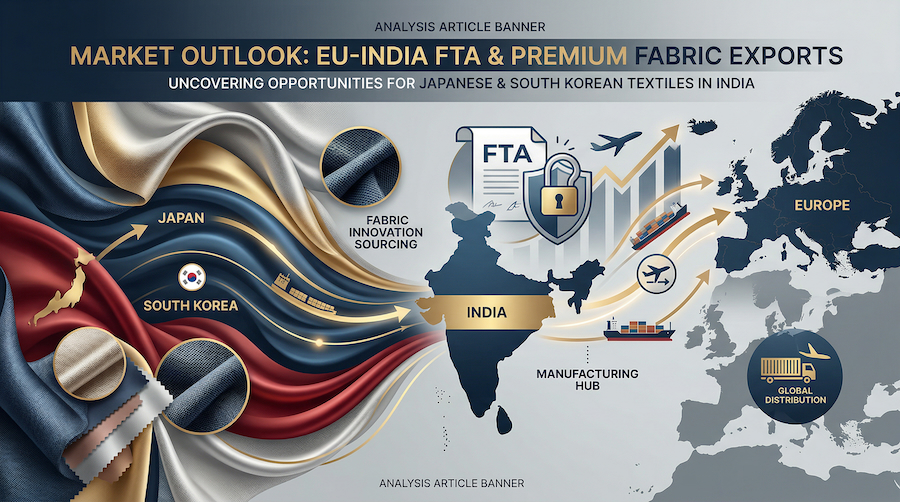
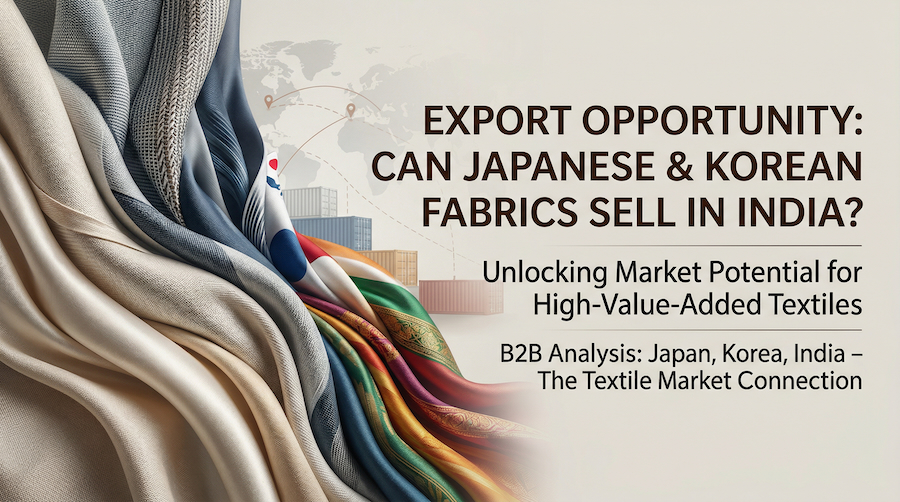
① EU-インドFTAとは何か ② インド繊維産業への関税メリット ③ 輸出拡大の数値予測 ④ EU側の非関税要件(サステナビリティ等) ⑤ 日本・韓国サプライヤーへの示唆 ⑥ 留意点・前提条件
① EU-インドFTA とは何か——交渉妥結までの経緯と主な内容
EU(欧州連合)とインドは2007年6月にFTA交渉を開始したが、2013年に停滞。2021年5月に再開し、2026年1月27日にニューデリーで開催された第16回EU-インド首脳会議において、交渉妥結が発表された。欧州委員会のウルズラ・フォン・デア・ライエン委員長はこれを「すべての取引の母(mother of all deals)」と称した。
重要な前提:2026年1月27日時点での「交渉妥結」であり、発効には欧州議会・EU理事会・インド議会の批准が必要。インド商工大臣ゴヤル氏は2026年中の発効を目指すと発言。ただし、GTRI(Global Trade Research Initiative)は発効まで「少なくとも1年」との見方を示している(EU-India Trade Council、2026年1月23日)。
② インド繊維・アパレル産業への関税メリット——数字で見る変化
FTA前、インドのアパレル・繊維製品はEUへの輸出に際して最大12%のMFN(最恵国)関税が課せられていた。一方、バングラデシュは「Everything But Arms(EBA)」フレームワークにより無関税アクセス、ベトナム・パキスタン・カンボジアも優遇制度で有利な立場にあった。この結果、インドはEUのテキスタイル輸入のわずか約5%(約72億ドル)しかシェアを持てていなかった。
出典:Textile Excellence「EU-India FTA: Impact On India’s Textile & Apparel Exports To EU」(2026年1月26日);Business Standard「India-EU FTA: A transformational opportunity for India’s textiles」(2026年2月2日)
Market Research Blog Vol.2 / India × Japan & Korea Fabric Sales × EU-India FTA
Can Japanese & Korean Fabrics Sell in India? (Part 2) — How the EU-India FTA Changes India’s Apparel Export Strategy and What It Means for Fabric Suppliers —
Compiled from published data by the European Commission, India Ministry of Commerce (PIB), Fibre2Fashion, Business Standard, Textile Excellence, CareEdge Ratings, RFKN Legal, BusinessToday, CNBC, ESCAP, and others.
Meet Indian Textile Manufacturers Directly
India Trend Fair Tokyo
Verify fabric needs, quality standards, and sourcing preferences directly with Indian apparel & garment manufacturers.
On January 27, 2026, India and the European Union announced the conclusion of negotiations for a comprehensive Free Trade Agreement (FTA)—described by both sides as the “mother of all deals.” The agreement’s most significant provision for the textile sector is the elimination of up to 12% import duties on Indian apparel and textile exports to the EU, effective upon entry into force. This structural shift carries direct implications for Japanese and Korean fabric suppliers: selling fabrics to Indian garment factories becomes equivalent to indirectly supplying into the EU market.
In short: With the EU eliminating tariffs on Indian apparel, Indian garment and apparel manufacturers now have a strong incentive to invest in quality upgrades and capacity expansion. This increases demand for premium input materials—fabrics—which creates an opportunity for Japanese and Korean fabric suppliers.
✏️ Editor’s Note
This article is a follow-up to our first piece, “Can Japanese & Korean Fabrics Sell in India? (Part 1).” The EU-India FTA was announced as a political milestone on January 27, 2026. Entry into force requires ratification by the European Parliament, EU Council, and Indian Parliament—a process expected to take at least one year (India Commerce Minister Piyush Goyal, press conference, January 27, 2026). This article contains only confirmed data and no inference or speculation.
① What Is the EU-India FTA? ② Tariff Benefits for India’s Textile Industry ③ Export Growth Forecasts ④ EU Non-Tariff Requirements ⑤ Implications for Japan & Korea ⑥ Key Caveats
① What Is the EU-India FTA? — Background and Key Provisions
EU-India FTA negotiations opened in June 2007, stalled in 2013, restarted in May 2021, and were concluded at the 16th EU-India Summit in New Delhi on January 27, 2026. European Commission President Ursula von der Leyen called it the “mother of all deals.”
The EU has committed to eliminating tariffs on approximately 97% of tariff lines covering over 99.5% of Indian export value. India has committed to liberalising approximately 92.1% of tariff lines covering 97.5% of EU export value. Bilateral goods trade reached €120 billion in 2024, with the EU as India’s largest trading partner.
Key caveat: The January 27, 2026 announcement is a political milestone—”negotiations concluded.” Entry into force requires ratification by the European Parliament, EU Council, and Indian Parliament. India’s Commerce Minister Goyal stated at a press conference that he expects the deal to enter into force in 2026. However, GTRI (Global Trade Research Initiative) indicates “at least one year” before implementation (EU-India Trade Council, January 23, 2026).
② Tariff Benefits for India’s Textile and Apparel Sector
Before the FTA, Indian apparel and textile exports to the EU faced MFN tariffs of up to 12%. Meanwhile, Bangladesh had zero-duty access under the “Everything But Arms (EBA)” framework, while Vietnam, Pakistan, and Cambodia also benefited from preferential arrangements. As a result, India held only about 5% of the EU’s textile import market (approximately $7.2 billion).
Sources: Textile Excellence “EU-India FTA: Impact On India’s Textile & Apparel Exports To EU” (January 26, 2026); Business Standard “India-EU FTA: A transformational opportunity for India’s textiles” (February 2, 2026)
Item
Before FTA
After FTA (upon entry into force)
Source
Apparel & clothing tariffs
9.6–12% (MFN)
Zero (immediate on entry into force)
Textile Excellence (Jan 2026)
Textile products overall
8–12% (MFN)
Zero across all tariff lines
PIB – India Ministry of Commerce (Jan 2026)
India’s textile exports to EU (2024-25)
~$7.2–8 billion
20–25% increase projected within 3 years (industry estimate)
Fibre2Fashion (Jan 2026)
EU textile import market (2024)
$263.5 billion (India’s share ~5%)
PIB (Jan 2026)
Comparison with China: China currently holds approximately 30% of EU apparel imports as the largest supplier. After FTA implementation, India will hold a 12% tariff advantage over China. CareEdge Ratings notes that “for global brands adopting a ‘China Plus One’ strategy, India’s competitiveness is set to increase significantly” (NewKerala, January 27, 2026).
③ Export Growth Forecasts — Confirmed Figures Only
Incremental RMG export forecast (3 years post-FTA)
$4–4.5B increase
CareEdge Ratings (Jan 2026)
India’s projected EU market share
5% → 8–9%
CareEdge Ratings (Jan 2026)
India’s total textile export long-term target
$100B
Target by 2030 (Business Standard, Feb 2026)
Textile Excellence states that “tariff elimination is expected to increase India’s apparel exports to the EU by 20–25% within three years. The leveling of competitive conditions with Bangladesh, Vietnam, and Cambodia will accelerate a shift toward higher value-added and sustainable product sourcing.”
Source: Textile Excellence “EU-India FTA: Impact On India’s Textile & Apparel Exports To EU” (January 26, 2026)
Product breakdown: Of India’s EU textile exports, RMG (ready-made garments) account for approximately 60%, cotton textiles 17%, and MMF products follow. Home textiles reached $1.54 billion in 2024. The top 5 EU destinations are Germany (18.7%), Netherlands (15.8%), Spain (13%), France (12.8%), and Italy (10.4%), together accounting for 70% of exports (Business Standard, February 2, 2026; PIB, January 27, 2026).
④ EU Non-Tariff Requirements — Zero Tariff Alone Is Not Enough
Keypoint Intelligence notes that “while tariff removal enhances cost competitiveness, long-term market share will be determined by the industry’s ability to meet escalating demands for sustainable production, digital print precision, and faster turnaround cycles” (January 30, 2026). Key confirmed requirements include:
🌿 Rules of Origin
Textiles and apparel are subject to “process rules” or “change in tariff classification (CTC) rules.” Fabrics sourced from Japan or Korea and simply cut and sewn in India may not qualify as “Indian origin.” Substantial transformation within India is required.
Source: India Ministry of Commerce “India-EU FTA FAQ” (PIB, January 29, 2026)
♻️ ESPR & Digital Product Passport
The EU’s Ecodesign for Sustainable Products Regulation (ESPR) is advancing Digital Product Passport (DPP) requirements for textiles and other products, mandating supply chain transparency and traceability.
Source: IMT Centre for Distance Learning “India-EU FTA 2026”; eeuropa.org
📋 CSDDD (Sustainability Due Diligence)
Effective from 2027, this EU directive requires companies to audit their value chains for human rights and environmental risks, increasing compliance requirements for Indian manufacturers.
The EU REACH regulation applies to most chemical substances including those in textiles and dyes. Chemical compliance in fabrics is required for market access.
Source: IMT Centre for Distance Learning “India-EU FTA 2026”
RFKN Legal states: “EU regulatory standards on chemicals, labelling, sustainability, and labour practices are stringent. Companies must take legal advice to ensure that they can assist Indian exporters in meeting these requirements and also conduct due diligence. Designing and completing documentation and certification that withstand customs scrutiny is critical.” (RFKN Legal, January 31, 2026)
⑤ Implications for Japanese & Korean Fabric Suppliers — Structural Facts Only
The following points are structural facts derived from the primary sources cited in this article. No inference is included.
Fact 1
Indian garment factories now have incentive to invest in quality and capacity for EU export
Fibre2Fashion reports: “Improved access to the EU market will prompt Indian manufacturers to invest in higher-value segments including technical and performance textiles, and to upgrade processes to meet European quality and sustainability standards.”
Source: Fibre2Fashion “India-EU FTA could reshape apparel and textile trade dynamics” (January 27, 2026)
Fact 2
The EU market specifically demands functional, value-added fabrics
Global Textile Times reports: “EU apparel buyers value not only cost reduction, but quality consistency, design-led products, and faster supply cycles. The sourcing shift toward India will target higher value-added product categories.”
Source: Global Textile Times “EU-India FTA: What It Means for European Textile Industry” (January 28, 2026)
Fact 3
India’s MMF sector has the largest growth potential for EU-bound exports
Fibre2Fashion reports: “EU apparel demand is heavily oriented toward MMF and blended products. Indian MMF hubs such as Surat are positioned to expand exports to Europe, offering integrated fabric-and-garment solutions while moving away from India’s traditionally cotton-heavy export profile.”
Source: Fibre2Fashion “India-EU FTA could reshape apparel and textile trade dynamics” (January 27, 2026)
Fact 4
Textile machinery and materials suppliers are expected to benefit from India’s investment cycle
RFKN Legal states: “As Indian exports to Europe grow, Indian manufacturers are likely to invest in better technology, specialised fabrics, advanced dyes, and finishing processes. European firms that supply textile machinery, chemicals, and technical inputs can find new commercial opportunities in this upgrading process.”
Source: RFKN Legal “Textiles under the India-EU FTA” (January 31, 2026)
📊 Structural Summary
With the EU eliminating tariffs on Indian apparel, Indian garment manufacturers have a clear incentive to expand EU exports. To meet EU requirements for quality, sustainability, and functionality, Indian manufacturers will invest in upgrading their input materials.
The opportunity for Japanese and Korean fabric suppliers exists specifically as “input material suppliers for EU-bound Indian garment production.” However, compliance with rules of origin (substantial transformation) and EU non-tariff requirements (REACH, sustainability) are prerequisite conditions.
Meet Indian Apparel & Garment Manufacturers Directly
India Trend Fair Tokyo
Fabric needs, applications, quality standards, price expectations — confirm directly with Indian manufacturers.
Organizer: Japan-India Industry Promotion Association (JIIPA) | india-trend-fair.jp
JIIPA
Japan-India Industry Promotion Association (NPO)
JIIPA is the NPO organizer of India Trend Fair Tokyo, dedicated to promoting economic, trade, and industrial collaboration between Japan and India (certified by Tokyo Metropolitan Government). Offices in Tokyo, New Delhi, and Mumbai.
The FTA was announced as concluded on January 27, 2026, but entry into force requires ratification by the European Parliament, EU Council, and Indian Parliament. Commerce Minister Goyal stated at a press conference he expects entry into force in 2026 (CNBC, January 27, 2026).
Rules of origin require substantial transformation within India. Fabrics sourced from Japan or Korea and simply sewn in India may not qualify as “Indian origin.” Verification is required (PIB FAQ, January 29, 2026).
CBAM (Carbon Border Adjustment Mechanism) currently covers steel, aluminum, etc., but not textiles. However, KPMG and others note the potential for future scope expansion (Fibre2Fashion, 2026).
Due to EU GSP “graduation,” certain Indian export categories face suspension of tariff preferences for 2026–2028. During the pre-FTA transition period, compliance is required (EU-India Trade Council, January 23, 2026).
Industry export growth forecasts are estimates from individual organizations and are not guaranteed outcomes.
시장 조사 블로그 Vol.2 / 인도 × 일본·한국 원단 판매 × EU-인도 FTA
일본·한국 원단은 인도에서 팔릴까? (제2회) — EU-인도 FTA가 바꾸는 인도 의류 수출 전략과 원단 공급사에 대한 시사점 —
유럽연합 집행위원회·인도 상공부(PIB)·Fibre2Fashion·Business Standard·Textile Excellence·CareEdge Ratings·RFKN Legal·BusinessToday·CNBC·ESCAP 등 각 기관 공표 자료를 토대로 편집
2026년 1월 27일, 인도와 유럽연합(EU)은 “모든 거래의 어머니”라 불리는 포괄적 자유무역협정(FTA) 협상 타결을 발표했다. 섬유 분야에서 가장 중요한 조항은 인도의 의류·섬유 수출에 부과되던 최대 12% 관세가 협정 발효 즉시 제로가 된다는 점이다. 이 구조적 변화는 일본·한국 원단 공급사에도 직접적인 함의를 가진다. 인도의 봉제공장에 원단을 판매하는 것이 곧 EU 시장을 간접적으로 공략하는 것과 연결되기 때문이다.
한마디로 요약하면: EU가 인도 의류 관세를 제로로 낮추면서, 인도의 봉제·의류 사업자는 EU 수출 확대를 위한 품질·설비 투자 유인이 생겼다. 그에 따른 고품질 소재(원단) 조달 수요 증가——이것이 일본·한국 원단 공급사에게 생기는 기회다.
✏️ 편집 후기
본 글은 전편 “일본·한국 원단은 인도에서 팔릴까? (제1회)”의 후속 편이다. EU-인도 FTA는 2026년 1월 27일 협상 타결이 발표되었으나, 발효를 위해서는 유럽의회·EU 이사회·인도 의회의 비준이 필요하다. 인도 상공부 장관 피유시 고얄은 2026년 발효를 목표로 한다고 발언했다. 본 글은 확인된 데이터만을 포함하며 추론이나 예측적 해석은 포함하지 않는다.
① EU-인도 FTA란? ② 인도 섬유산업의 관세 혜택 ③ 수출 성장 예측 ④ EU 비관세 요건 ⑤ 일본·한국 공급사에 대한 시사점 ⑥ 유의사항
① EU-인도 FTA란? — 협상 경위와 주요 내용
EU-인도 FTA 협상은 2007년 6월 개시, 2013년 중단, 2021년 5월 재개 후 2026년 1월 27일 뉴델리에서 열린 제16차 EU-인도 정상회의에서 협상 타결이 발표되었다. 유럽위원회 폰 데어 라이엔 위원장은 이를 “모든 거래의 어머니”라고 불렀다.
EU는 관세 라인의 약 97%·인도 수출액의 99.5% 이상에 대해 관세를 철폐하거나 삭감할 것을 약속했다. 인도는 관세 라인의 약 92.1%·수출액의 97.5%를 자유화한다. 2024년 물품 교역 총액은 1,200억 유로에 달하며 EU는 인도 최대 교역 파트너다.
출처: EU 집행위원회 “EU-India Free Trade Agreement: Chapter-by-Chapter Summary” (2026년 2월 2일)
중요한 전제: 2026년 1월 27일 발표는 “협상 타결”이지 “발효”가 아니다. 발효를 위해서는 유럽의회·EU 이사회·인도 의회의 비준이 필요하다. 인도 상공부 장관 고얄은 2026년 중 발효를 목표로 한다고 발언했으나, GTRI는 발효까지 “최소 1년”으로 보고 있다 (EU-India Trade Council, 2026년 1월 23일).
② 인도 섬유·의류 산업에 대한 관세 혜택 — 수치로 보는 변화
FTA 이전 인도의 의류·섬유 제품은 EU 수출 시 최대 12%의 MFN(최혜국) 관세가 부과되었다. 반면 방글라데시는 “Everything But Arms(EBA)” 프레임워크로 무관세 접근, 베트남·파키스탄·캄보디아도 우대 제도의 혜택을 받았다. 그 결과 인도는 EU 섬유 수입의 약 5%(약 72억 달러)에 불과한 점유율을 차지하고 있었다.
출처: Textile Excellence “EU-India FTA: Impact On India’s Textile & Apparel Exports To EU” (2026년 1월 26일); Business Standard (2026년 2월 2일)
항목
FTA 이전
FTA 이후 (발효 시)
출처
의류·봉제품 관세
9.6~12%(MFN)
제로(발효 즉시)
Textile Excellence (2026년 1월)
섬유 제품 전반
8~12%(MFN)
전 관세 라인 제로
PIB 인도 상공부 (2026년 1월)
EU 섬유 수출액 (2024-25년도)
약 72~80억 달러
3년 이내 20~25% 증가 전망(업계 예측)
Fibre2Fashion (2026년 1월)
EU 섬유 수입 시장 규모 (2024년)
2,635억 달러(인도 점유율 약 5%)
PIB (2026년 1월)
중국과의 비교: EU 의류 수입에서 중국은 현재 약 30%의 점유율을 가진 최대 공급국이지만, FTA 발효 후 인도는 “중국에 대해 12%의 관세 우위”를 갖게 될 전망이다. CareEdge Ratings의 보고서는 “‘중국+1 전략’을 채택하는 글로벌 브랜드에 있어 인도의 경쟁력이 한층 높아진다”고 분석하고 있다 (NewKerala, 2026년 1월 27일).
③ 수출 성장 예측 — 확인된 수치만
기성복 증가 수출 예측(발효 후 3년)
40~45억 달러 증가
CareEdge Ratings (2026년 1월)
EU에서 인도의 점유율 전망
5% → 8~9%
CareEdge Ratings (2026년 1월)
인도 섬유 수출 장기 목표
1,000억 달러
2030년 목표 (Business Standard, 2026년 2월)
Textile Excellence는 “관세 철폐로 인도의 EU 의류 수출은 3년 이내 20~25% 증가할 전망이다. 방글라데시·베트남·캄보디아와의 가격 경쟁 조건이 균등화됨으로써, 부가가치가 높은 카테고리·지속가능 제품으로의 소싱 전환이 가속화된다”고 분석하고 있다.
출처: Textile Excellence “EU-India FTA: Impact On India’s Textile & Apparel Exports To EU” (2026년 1월 26일)
제품별 내역: 인도의 EU 섬유 수출 중 기성복(RMG)이 약 60%, 면 제품 17%, 화합섬이 그 다음. 홈텍스타일은 2024년도에 15.4억 달러. 주요 수출지는 독일(18.7%)·네덜란드(15.8%)·스페인(13%)·프랑스(12.8%)·이탈리아(10.4%)의 5개국이 70%를 차지한다 (Business Standard, 2026년 2월 2일; PIB, 2026년 1월 27일).
④ EU 비관세 요건 — 관세 제로만으로는 진입 불가
Keypoint Intelligence는 “관세 철폐가 비용 경쟁력을 높이는 반면, 장기적인 시장 점유율은 지속 가능한 생산, 디지털 인쇄 정밀도, 빠른 턴어라운드 사이클에 대한 EU 측의 요구에 얼마나 부응하는가에 달려 있다”고 지적하고 있다 (2026년 1월 30일).
🌿 원산지 규정(Rules of Origin)
섬유·의류에는 “공정 룰” 또는 “관세 분류 변경(CTC) 룰”이 적용된다. 일본·한국산 원단을 인도에서 봉제한 것만으로는 “인도 원산”으로 인정받지 못할 수 있다. 인도 내 실질적 가공·변환이 필요하다.
출처: 인도 상공부 “India-EU FTA FAQ” (PIB, 2026년 1월 29일)
♻️ ESPR·디지털 제품 여권
EU의 ‘에코디자인 지속가능제품규정(ESPR)’은 섬유를 포함한 제품에 대한 디지털 제품 여권(DPP) 의무화를 추진 중이다. 공급망 투명성·트레이서빌리티가 요구된다.
출처: IMT Centre for Distance Learning “India-EU FTA 2026”; eeuropa.org
📋 CSDDD(지속가능성 실사)
2027년 시행 예정인 EU 지침으로, 기업은 공급망 전반에 걸쳐 인권·환경 리스크를 감사할 의무를 진다. 인도 제조업체에 대한 컴플라이언스 요구가 증가할 것으로 예상된다.
출처: drishtiias.com “India-EU FTA” (2026년 1월 28일)
⚗️ REACH 규정
EU REACH 규정(화학물질의 등록·평가·허가)은 섬유·염료를 포함한 광범위한 제품에 적용된다. 원단에 포함된 화학물질의 컴플라이언스가 필요하다.
출처: IMT Centre for Distance Learning “India-EU FTA 2026”
RFKN Legal은 “화학물질·라벨링·지속가능성·노동 관행에 관한 EU 규제 기준은 엄격하다. 인도 수출업체가 이러한 요건을 충족할 수 있도록 법적 조언을 구하고, 관세 조사를 견딜 수 있는 문서화와 인증 완료가 중요하다”고 밝히고 있다 (RFKN Legal, 2026년 1월 31일).
⑤ 일본·한국 원단 공급사에 대한 시사점 — 확인된 사실만
다음 각 항목은 본 글이 인용하는 1차 자료의 내용에서 구조적으로 확인할 수 있는 사실이다. 추론은 포함하지 않는다.
사실①
인도 봉제공장은 EU 수출 확대를 위한 품질·설비 투자 유인이 생겼다
Fibre2Fashion은 “EU 시장으로의 접근성 향상으로 인도 제조업체는 기술 섬유·고기능 소재 등 부가가치가 높은 분야에 투자를 확대하고, 유럽의 품질·지속가능성 기준을 충족하기 위한 설비 투자가 증가할 것”이라고 보고하고 있다.
출처: Fibre2Fashion “India-EU FTA could reshape apparel and textile trade dynamics” (2026년 1월 27일)
사실②
EU 시장은 기능성·부가가치 원단을 명확히 요구하고 있다
Global Textile Times는 “EU 의류 바이어는 비용 절감뿐 아니라 품질의 안정성·디자인 주도형 제품·단기 공급 사이클을 중시하며, 인도로의 소싱 전환은 부가가치가 높은 제품 카테고리를 향해 가고 있다”고 분석하고 있다.
출처: Global Textile Times “EU-India FTA: What It Means for European Textile Industry” (2026년 1월 28일)
사실③
인도의 화합섬(MMF) 부문이 EU 향 수출에서 가장 큰 성장 여지를 가진다
Fibre2Fashion은 “EU 의류 수요의 상당 부분이 MMF 및 혼방 소재로 이루어져 있는 가운데, 인도의 화합섬 허브(예: 수라트)는 유럽을 향해 수출을 확대할 전망이다. 원단과 봉제를 통합한 솔루션 제공이 가능해진다”고 언급하고 있다.
출처: Fibre2Fashion “India-EU FTA could reshape apparel and textile trade dynamics” (2026년 1월 27일)
사실④
섬유 기계·소재 공급사가 인도의 투자 사이클로부터 혜택을 받을 것으로 예측
RFKN Legal은 “EU 수출이 늘어남에 따라 인도 제조업체는 우수한 기술·특수 원단·첨단 염색·마감 공정에 투자하게 된다. 섬유 기계·화학품·기술적 인풋을 공급하는 기업이 이 업그레이드 과정에서 새로운 사업 기회를 얻을 수 있다”고 밝히고 있다.
출처: RFKN Legal “Textiles under the India-EU FTA” (2026년 1월 31일)
📊 구조 요약 — 원단 공급사가 확인할 수 있는 것
EU가 인도 의류 관세를 제로로 낮춘 결과, 인도의 봉제·의류 사업자는 EU 수출 확대를 향한 명확한 유인을 갖게 되었다. EU 측이 요구하는 기준(기능성·지속가능성·트레이서빌리티)에 대응하기 위해 인도 제조업체는 원단·소재의 품질 수준을 높이는 투자를 진행한다.
일본·한국의 원단 공급사가 “EU 기준 적합 인도 봉제품을 위한 인풋 소재 공급사”로서 참여할 여지는 바로 이 점에 존재한다. 단, 원산지 규정(실질적 변환)에의 대응과 EU 비관세 요건(REACH·지속가능성)에의 대응이 전제 조건이 된다.
FashionatingWorld「The Fabric of Trade」は「インド国内業界団体(全インド・ニッターズ協会)の試算によれば、輸入品の30〜40%が不当廉価(アンダーインボイシング)であり、実際の輸入量は公式統計より20〜30%多い可能性がある」と指摘している。
Indian Textile Journal(2024年)は「インドと中国の生地価格差の大きな要因は原材料コストにある。2024年6月時点でインドのPSF・VSFの価格は中国比でそれぞれ約38%・19%高い」と報告している。
出典:FashionatingWorld「The Fabric of Trade」;Indian Textile Journal(2024年)
Fibre2Fashion「India Budget 2025: Industry seeks to curb fabric import flooding」(2025年1月)によれば、業界団体NITMAは「中国のメーカーはASEAN諸国(タイ・インドネシア・マレーシア)経由でインドとの貿易協定を活用してダンピング輸出を行っている。輸入業者が実際に$1/kg程度で申告するケースがあり、実際のグローバル価格$4〜6/kgとの差異が問題だ」と警告している。
Techtextil India 2025(Indian Textile Magazine、2025年11月)によれば「国際参加国としてベルギー・ドイツ・香港・イタリア・日本・スウェーデン・米国が参加し、500以上の製品・300以上のブランドが展示された」。日本の技術テキスタイルがインド市場で存在感を示している。
出典:The Textile Magazine「Techtextil India 2025」(2025年11月)
India’s garment and apparel industry is expanding rapidly. The domestic apparel market reached $115.7 billion in 2024 and is projected to grow to $171.6 billion by 2034 (TOP 20 INDIA APPAREL MARKET CONSUMER STATISTICS 2025). How is fabric procurement working for this massive consumer market — and what opportunities exist for Japanese and Korean textile trading companies to sell fabrics there? This article organizes confirmed data and citations. No inference is included.
In short: competing in commodity fabrics for mass consumption is extremely difficult, but confirmed demand exists in high-performance, functional, and luxury segments. However, clear barriers in the form of import restrictions, tariffs, and domestic protection policies also exist.
✏️ Editor’s Note
This article was prompted by a visit from a Korean textile trading company, during which the topic of selling fabrics in India came up. We decided to research the subject thoroughly.
For those considering fabric sales in India, we highly recommend Bharat Tex — a major textile industry trade show scheduled for July 2026 near New Delhi, India. Registration is currently open for both exhibitors and buyers. Registered buyers may receive accommodation support of up to 4 nights at a 5-star equivalent hotel (subject to screening). Please consider attending if you are exploring entry into the Indian market.
① India’s Fabric Import Landscape ② China’s Dominance & Price Competition ③ India’s Import Regulations & Tariffs ④ Where Japan & Korea Excel ⑤ India’s Luxury & Premium Market ⑥ Confirmed Japan–India Collaborations ⑦ Key Considerations for Market Entry
① India’s Fabric Import Landscape — Role of Imported Fabrics in a Growing Apparel Market
India’s apparel market reached $115.7 billion in 2024 and is forecast to grow to $171.6 billion by 2034 (TOP 20 INDIA APPAREL MARKET CONSUMER STATISTICS 2025). The broad base of the garment industry means domestic fabric manufacturers cannot fully meet all demand segments.
According to FashionatingWorld’s “The Fabric of Trade,” India imported $6.4 billion worth of fabrics from China in FY2022-23 (full year), primarily synthetic and knitted fabrics. In the April–December period alone, imports reached $3.7 billion — a 40% year-on-year increase.
Source: FashionatingWorld, “The Fabric of Trade: Chinese imports loom large over India’s textile industry”
India Apparel Market (2024)
$115.7B
Projected $171.6B by 2034
India’s Fabric Imports from China (FY2022-23)
$6.4B
Mainly synthetic & knitted fabrics
India Luxury Fashion Market (2025)
$9.85B
$15.17B by 2034 (CAGR 4.92%)
Sources: TOP 20 INDIA APPAREL MARKET CONSUMER STATISTICS 2025; FashionatingWorld; IMARC Group “India Luxury Fashion Market”
② China’s Dominant Market Share & the Price Competition Japan and Korea Face
China dominates India’s fabric import market. FashionatingWorld states that the All India Knitters’ Association estimates 30–40% of imports are underinvoiced, meaning actual import volumes could be 20–30% higher than official statistics.
Indian Textile Journal (2024) reports that a major reason for the price gap is India’s high raw material costs: as of June 2024, India’s PSF and VSF prices were approximately 38% and 19% higher respectively than in China.
Sources: FashionatingWorld “The Fabric of Trade”; Indian Textile Journal (2024)
Fibre2Fashion (January 2025) reports that industry body NITMA warns Chinese manufacturers are routing exports through ASEAN countries (Thailand, Indonesia, Malaysia) to exploit India’s trade agreements, with importers declaring prices as low as $1/kg against a global market price of $4–6/kg.
Entry into the low-price commodity segment where Japanese/Korean fabrics would directly compete is extremely difficult. At the same time, this means there is room to differentiate on non-price value — quality, functionality, and brand power.
③ India’s Import Regulations & Tariffs — Strengthened Protections in the 2025 Budget
Regulation / Tax
Details
Source
Basic Customs Duty (BCD)
9 knitted fabric categories: “20% or ₹115/kg, whichever is higher” (from Feb 1, 2025)
Fibre2Fashion (Feb 2025)
Minimum Import Price (MIP)
$3.50/kg (CIF) on 13 HSN codes of synthetic knitted fabrics. SEZ/EOU/Advance Auth holders exempt if not selling to domestic market
Fibre2Fashion (Oct 2024)
IGST
5–12% applied to the assessable value (after BCD and other charges). Equivalent to domestic GST on imports
India Briefing
Social Welfare Surcharge (SWS)
10% of BCD (exempt for certain tariff lines)
Karbon Card
Impact on Consumers
Tariffs have added 15–20% to clothing costs for Indian consumers (ICRIER study)
GZHenry Textile
Key point: High tariffs raise input costs for garment exporters and reduce their global competitiveness (GZHenry Textile). Using premium imported fabrics only works economically in niche, high-value-added segments where the additional cost can be absorbed into export pricing.
④ Where Japan & Korea Excel — Functional & Technical Textiles
Mordor Intelligence’s “Asia-Pacific Textile Industry” (March 2026) states that “Japan and South Korea specialize in high-value technical textiles, including carbon fiber, aramid, and smart textiles, exporting high-margin products.” This strength can serve as an effective differentiator for fabric sales in India.
🔧 Technical Textiles & Industrial Applications
Techtextil India 2025 (Indian Textile Magazine, November 2025) reported international participation from Belgium, Germany, Hong Kong, Italy, Japan, Sweden, and the USA, with 500+ products and 300+ brands exhibited — confirming Japan’s visible presence in India’s technical textile market.
Source: The Textile Magazine, “Techtextil India 2025” (Nov 2025)
🔥 Flame-Retardant & Protective Apparel
FashionatingWorld “Techtextil 2025” (December 2025) specifically reported the partnership between Brawntex Industries and Japan’s Kurabo Industries, aimed at introducing advanced fire-retardant fabrics to India’s military and industrial workwear segments, targeting oil, gas, iron, and steel industries.
IMARC Group (cited in Just-Style, April 2025) projects India’s sportswear market to grow from $10.2B in 2024 to $16.6B by 2033 (CAGR 5.1%). Techtextil India 2025 launched a dedicated Sporttech Pavilion with demand for innovative textiles offering moisture management, compression, breathability, and eco-friendly options.
Source: Just-Style (Apr 2025); IMARC Group
Mordor Intelligence “Global Textile Industry Forecast 2030” (2025) notes that India is working to strengthen domestic technical textile production capacity through PM MITRA industrial parks and expanded PLI schemes, suggesting demand for Japanese and Korean technical collaboration will continue.
⑤ India’s Luxury & Premium Market — Opportunity and Reality
IMARC Group’s “India Luxury Fashion Market” states the market was valued at $9.85 billion in 2025, projected to reach $15.17 billion by 2034 (CAGR 4.92%). Clothing and apparel dominate with 61% market share, with consumers increasingly valuing premium fabrics, intricate detailing, and limited-edition designs.
BoF-McKinsey “State of Fashion 2025” (November 2024) noted that India has become a key global fashion market with 12–17% growth forecast for 2025, and one in five fashion executives cited India as a focus market.
Sources: IMARC Group; BoF-McKinsey “State of Fashion 2025” (Nov 2024)
✅ Confirmed Demand for Premium Fabrics
Outlook Luxe (January 2026) reported that India’s luxury goods market grew 10% to $12.1 billion in 2025 per Euromonitor International, driven by expanding affluence, rapid urbanization, and strong appetite for premium products.
⚠️ High Import Tariffs are the Major Barrier
Retail Dive states import duties on luxury goods in India average 30–40%. Combined with transportation costs, it is often cheaper for Indians to purchase abroad — a reality that limits the premium import fabric market’s accessibility.
Kurabo Industries × Brawntex Industries — Fire-Retardant Fabrics for Indian Military & Industrial Segments
Reported by FashionatingWorld “Techtextil 2025” (December 2025): “The partnership between Brawntex Industries and Japan’s Kurabo Industries aims to introduce advanced fire-retardant fabrics to India’s military and industrial workwear segments, reflecting a broader strategy of shifting toward domestic production of high-specification textiles for oil & gas, iron, and steel sectors.”
Japanese Trading Houses (ITOCHU, Toray, etc.) in India’s Textile Business
ITOCHU Corporation describes its textile business — handling textile materials, fabrics, and apparel accessories — as its founding business, with global expansion ongoing (ITOCHU official website). Toray Industries continues deploying high-performance materials in global textile markets including India.
Source: ITOCHU Corporation official website
Case 3
Korean Fabrics toward India
Kohantextilejournal “Top Textile Countries 2025” (2025) states that East Asian nations (Japan, South Korea, China) export specialty yarns, synthetic fibers, and high-quality cotton to India. SPMRF also identified the strategy of attracting Korean textile investment to India (Gujarat state) and drawing Korean buyers away from Chinese markets.
Sources: Kohantextilejournal (2025); SPMRF “India’s Textile Trade with Japan”
⑦ Key Considerations When Evaluating Market Entry
📋 Tariff & Cost Calculation
Calculate BCD + SWS (10% of BCD) + IGST (typically 5–12%) accurately. For knitted fabrics: BCD is “20% or ₹115/kg, whichever is higher” (from Feb 2025). Total tariff burden can exceed 30–40% for certain categories.
🎯 Target Segment Selection
Mass-market commodity fabrics face inevitable price competition from China ($6.4B annual imports). Concentrating on functional textiles, technical textiles, luxury, and bridal segments — where China has less competitive advantage — is the confirmed approach (Mordor Intelligence, FashionatingWorld).
🏙 Priority Market Identification
Luxury retail stores remain concentrated in major metros (Mumbai, Delhi, Bangalore) (BusinessToday, IMARC). The most practical initial approach is to target apparel manufacturers and designer brands in major metropolitan areas.
📄 Required Documentation & Regulations
Patron Accounting states: “IEC registration, ICEGATE registration, AD Code, and GST registration are mandatory.” HS classification (Chapters 50–63) directly determines duty rates; verification with CBIC’s tariff schedule or a licensed customs broker before import is strongly recommended.
📌 Summary of Research Findings
Entry into mass-market commodity fabrics is currently extremely difficult due to China’s overwhelming price advantage and tightening import regulations (MIP, tariff increases). However, confirmed demand and collaboration examples exist in: ① functional/technical textiles (flame-retardant, sports, medical); ② high-value-added premium fabrics (Japanese jacquards, special-finish materials); and ③ quality-differentiating fabrics for Indian garment makers’ export products.
With India’s luxury fashion market growing at CAGR 4.92% (IMARC) and BoF-McKinsey (2024) identifying India as a key 2025 focus market, medium-to-long-term entry potential exists. However, high import tariffs (averaging 30–40%, Retail Dive) represent a clear barrier — accurate final price modeling is the essential starting point for any entry decision.
Meet Indian Apparel Manufacturers & Textile Buyers Directly
India Trend Fair Tokyo
Fabric needs, applications, quality standards, price expectations — confirm directly with Indian manufacturers.
Organizer: Japan-India Industry Promotion Association (JIIPA) | india-trend-fair.jp
JIIPA
Japan-India Industry Promotion Association (NPO)
JIIPA (Japan-India Industry Promotion Association) is the NPO organizer of India Trend Fair Tokyo, dedicated to promoting economic, trade, and industrial collaboration between Japan and India (certified by Tokyo Metropolitan Government). Offices in Tokyo, New Delhi, and Mumbai.
인도의 봉제·의류 산업은 급속히 성장하고 있다. 국내 의류 시장은 2024년 1,157억 달러에 달했으며, 2034년에는 1,716억 달러로 성장할 것으로 전망된다(「TOP 20 INDIA APPAREL MARKET CONSUMER STATISTICS 2025」). 이 거대한 소비 시장을 지탱하는 ‘원단(패브릭)’ 조달은 어떻게 이루어지고 있을까—그리고 일본·한국 섬유 상사가 원단을 판매할 기회는 있을까. 본고에서는 확인된 데이터와 인용을 바탕으로 정리한다. 추론은 포함하지 않는다.
결론을 먼저 말하자면, 대량 소비용 범용 원단에서의 경쟁은 극히 어렵지만, 고성능·기능성·고급 분야에는 확인된 수요가 있다. 다만 수입 규제·관세·국내 보호 정책이라는 명확한 장벽도 존재한다.
✏️ 편집 후기
얼마 전 한국의 섬유 상사 관계자분들이 방문하셔서 인도에서의 원단 판매에 관한 이야기를 나누게 되었고, 이를 계기로 이번 조사를 진행하였습니다.
인도 시장 진출을 검토 중이신 분들께 꼭 알려드리고 싶은 전시회가 있습니다. 2026년 7월 인도 뉴델리 인근에서 개최 예정인 섬유 업계 대형 전시회 「Bharat Tex」에는 현재 출전사 및 바이어 모두 등록이 가능합니다. 바이어로 등록하시면 최대 4박까지 5성급 호텔 숙박비 지원을 받으실 수 있습니다(심사 있음). 인도 시장 진출을 고려하고 계신 분들의 적극적인 참가를 권장합니다.
① 인도 원단 수입 현황 ② 중국의 압도적 점유율과 가격 경쟁 ③ 인도의 수입 규제·관세 실태 ④ 일본·한국의 강점이 발휘되는 분야 ⑤ 인도의 고급·프리미엄 시장 ⑥ 확인된 일본·한국×인도 섬유 협력 사례 ⑦ 진입 검토 시 확인 사항
① 인도 원단 수입 현황 — 성장하는 의류 시장과 수입 원단의 역할
인도의 의류 시장은 2024년 1,157억 달러에 달했으며, 2034년 1,716억 달러로 성장이 전망된다(「TOP 20 INDIA APPAREL MARKET CONSUMER STATISTICS 2025」). 이 성장을 뒷받침하는 봉제 산업의 저변은 넓어, 국내 원단 제조업체만으로는 모든 수요를 충족하기 어려운 영역이 존재한다.
FashionatingWorld 「The Fabric of Trade」에 따르면 「2022~23회계연도(연간) 인도는 중국에서 64억 달러 상당의 원단을 수입하였으며, 주로 합성 섬유와 니트 원단이었다」. 같은 회계연도 4~12월 기간에만 37억 달러(전년 대비 40% 증가)에 달했다.
출처: FashionatingWorld 「The Fabric of Trade: Chinese imports loom large over India’s textile industry」
인도 의류 시장 (2024년)
$1,157억
2034년 $1,716억 전망
인도의 중국 원단 수입 (2022~23년)
$64억
주로 합성 섬유·니트 원단
인도 럭셔리 패션 시장 (2025년)
$98.5억
2034년 $151.7억 전망 (CAGR 4.92%)
출처: TOP 20 INDIA APPAREL MARKET CONSUMER STATISTICS 2025; FashionatingWorld; IMARC Group
② 중국의 압도적 점유율과 일본·한국이 직면한 가격 경쟁
FashionatingWorld는 「인도 전 니트업자 협회(All India Knitters’ Association)의 추산에 따르면 수입품의 30~40%가 저가 신고(언더인보이싱)이며, 실제 수입량은 공식 통계보다 20~30% 많을 가능성이 있다」고 지적하고 있다.
Indian Textile Journal(2024년)은 「인도와 중국의 원단 가격 차이의 주요 요인은 원자재 비용이다. 2024년 6월 기준, 인도의 PSF·VSF 가격은 중국 대비 각각 약 38%·19% 높다」고 보고하고 있다.
출처: FashionatingWorld; Indian Textile Journal (2024년)
Fibre2Fashion(2025년 1월)에 따르면 업계 단체 NITMA는 「중국 제조업체들이 태국·인도네시아·말레이시아 등 ASEAN 국가를 경유해 인도와의 무역협정을 악용하여 덤핑 수출을 하고 있다. 수입업자가 $1/kg 수준으로 신고하는 사례가 있으며, 실제 글로벌 가격 $4~6/kg과의 차이가 문제」라고 경고하고 있다.
일본·한국 원단이 직접 경쟁하는 저가 구간에서의 진입은 극히 어렵다. 동시에 이는 가격 이외의 가치(품질·기능·브랜드력)로 차별화할 여지가 있다는 의미이기도 하다.
③ 인도의 수입 규제·관세 실태 — 2025년 예산으로 강화된 보호 조치
규제·세금 종류
내용
출처
기본 관세(BCD)
니트 원단 9개 품목: 「20% 또는 115루피/kg 중 높은 쪽」(2025년 2월부터)
Fibre2Fashion (2025년 2월)
최저 수입 가격(MIP)
합성 니트 원단 13개 HSN 코드에 $3.5/kg(CIF). SEZ·EOU 등 국내 판매 없을 시 면제
Fibre2Fashion (2024년 10월)
IGST
BCD 등 가산 후 과세 표준에 5~12% 적용
India Briefing
사회복지 부가세(SWS)
BCD의 10% 상당(일부 품목 면제)
Karbon Card
소비자 영향
관세로 인해 인도 소비자의 의류 비용이 15~20% 상승(ICRIER 조사)
GZHenry Textile
중요 포인트: 높은 관세는 의류 수출 기업에게 수입 원단 비용 상승을 초래하여 글로벌 경쟁력을 저하시킨다. 고품질 수입 원단을 사용하려면 관세 비용을 부가하더라도 수출 경쟁력을 유지할 수 있는 틈새·고부가가치 분야에서만 성립하는 구조다(GZHenry Textile).
④ 일본·한국의 강점이 발휘되는 분야 — 기능성·테크니컬 텍스타일
Mordor Intelligence 「Asia-Pacific Textile Industry」(2026년 3월)는 「일본과 한국은 탄소 섬유·아라미드·스마트 텍스타일 등 고부가가치 기술 텍스타일에 특화하여 고마진 수출을 하고 있다」고 분석하고 있다.
🔧 테크니컬 텍스타일·산업 용도
Techtextil India 2025(Indian Textile Magazine, 2025년 11월)에 따르면 「국제 참가국으로 벨기에·독일·홍콩·이탈리아·일본·스웨덴·미국이 참가하여 500개 이상의 제품과 300개 이상의 브랜드가 전시되었다」. 일본의 기술 텍스타일이 인도 시장에서 존재감을 보이고 있음을 확인할 수 있다.
출처: The Textile Magazine 「Techtextil India 2025」(2025년 11월)
🔥 방염·보호 의류용
FashionatingWorld 「Techtextil 2025」(2025년 12월)는 「Brawntex Industries와 일본 Kurabo Industries(쿠라보방적)의 파트너십으로 고도의 방염 원단을 인도 군·산업용 워크웨어 분야에 도입하는 취지가 진행 중」이라고 구체적으로 보고하고 있다.
IMARC Group에 따르면 「인도 스포츠웨어 시장은 2024년 102억 달러에서 2033년 166억 달러로 성장 전망(CAGR 5.1%)」. Techtextil India 2025에서는 「Sporttech Pavilion」이 신설되어 기능성 소재에 대한 수요가 높아지고 있다(Just-Style, 2025년 4월).
출처: Just-Style(2025년 4월); IMARC Group
Mordor Intelligence 「Global Textile Industry Forecast 2030」(2025년)은 「인도는 PM MITRA 산업 파크와 PLI 스킴의 정책 지원을 받아 기술 텍스타일의 자국 생산 능력을 강화하려 하고 있다」고도 지적하고 있어, 일본·한국 기술과의 협력 수요는 당분간 지속될 것으로 보인다.
⑤ 인도의 고급·프리미엄 시장 — 가능성과 현실
IMARC Group에 따르면 「인도 럭셔리 패션 시장은 2025년 98.5억 달러로, 2034년 151.7억 달러 성장 전망(CAGR 4.92%). 의류·어패럴이 시장의 61%를 차지하며, 소비자들은 고품질 원단·정교한 디테일·한정판 디자인을 중시하고 있다」.
BoF-McKinsey 「State of Fashion 2025」(2024년 11월)는 「인도는 미드마켓 중심으로 2025년 12~17% 성장이 전망되는 주요 글로벌 패션 시장이 되었다. 패션 업계 임원 5명 중 1명이 인도를 2025년 중점 시장으로 꼽았다」고 평가하고 있다.
출처: IMARC Group; BoF-McKinsey 「State of Fashion 2025」(2024년 11월)
✅ 프리미엄 원단에 대한 수요가 존재
Outlook Luxe(2026년 1월)에 따르면 「인도 럭셔리 시장은 Euromonitor 전망에서 2025년 10% 성장하여 121억 달러에 달했다」. 인도 디자이너 브랜드들은 글로벌 진출을 위해 원단의 품질 향상을 요구하고 있다.
⚠️ 높은 수입 관세가 최대 장벽
Retail Dive는 「인도의 고급품에 대한 수입 관세는 평균 30~40%이며, 수송비를 더하면 인도보다 해외에서 구입하는 것이 저렴한 경우가 많다」고 지적하고 있다.
⑥ 확인된 일본·한국×인도 섬유 협력 사례
사례①
쿠라보방적(Kurabo)×Brawntex Industries — 방염 원단의 인도 군·산업 분야 전개
FashionatingWorld 「Techtextil 2025」(2025년 12월)가 보고한 구체적인 일본·인도 협력 사례. 「BrawntexとKurabo Industries의 파트너십은 고도의 방염 원단을 인도 군·산업용 워크웨어 분야에 도입하는 것을 목적으로 한다」.
이토추상사는 「텍스타일 소재·원단·의류 자재를 취급하는 섬유 사업의 창업 비즈니스」로서 국제 전개를 하고 있다(ITOCHU 공식 웹사이트). 도레이(Toray Industries)는 글로벌 섬유 시장에서 고기능 소재의 전개를 이어가고 있다.
출처: ITOCHU Corporation 공식 웹사이트
사례③
한국 원단·인도 향 대응
Kohantextilejournal 「Top Textile Countries 2025」(2025년)는 「동아시아 국가들(일본·한국·중국)은 특수 원사·합성 섬유·고품질 면화를 인도에 수출하고 있다」고 기재하고 있다. 또한 SPMRF는 「한국 투자를 인도 텍스타일 섹터(구자라트 주)에 유치하고, 비용 우위가 있는 한국 바이어를 중국 시장에서 끌어오는」 전략적 가능성을 지적하고 있다.
출처: Kohantextilejournal(2025년); SPMRF
⑦ 진입 검토 시 확인해야 할 사항
📋 관세·비용 계산
BCD+SWS(BCD×10%)+IGST(통상 5~12%)의 합계를 정확히 산출. 니트 원단은 BCD「20% 또는 115루피/kg 중 높은 쪽」(2025년 2월~). 품목에 따라 30~40% 이상의 관세 부담이 될 가능성이 있다.
🎯 타겟 세그먼트 선정
대량 소비용 범용 원단은 중국과의 가격 경쟁이 불가피(인도로의 중국 원단 연간 64억 달러). 기능성·테크니컬·고급·웨딩용 등 중국이 취약한 영역에 집중하는 것이 확인된 접근법이다(Mordor Intelligence·FashionatingWorld).
🏙 우선 시장 특정
럭셔리 소매 실물 점포는 여전히 대도시(뭄바이·델리·방갈로르)에 집중하고 있다(BusinessToday·IMARC). 첫 번째 접근은 대도시권의 의류 제조업체·디자이너 브랜드가 현실적이다.
📄 필요 서류·규제 확인
「IEC 취득·ICEGATE 등록·AD 코드·GST 등록이 필수」(Patron Accounting). 품목의 HS 분류(Chapter 50~63)는 관세율과 직결되므로 수입 전에 CBIC 관세 스케줄 또는 라이선스 통관업자에게 확인하는 것이 권장된다.
📌 조사에서 확인할 수 있는 요약
대량·범용품 진입은 중국의 압도적인 가격 우위와 수입 규제(MIP·관세 강화)로 인해 현재로서는 극히 어렵다. 반면 ①기능성·테크니컬 텍스타일(방염·스포츠·의료), ②고부가가치 고급 원단, ③인도 의류 제조업체가 수출 제품에 사용하는 품질 차별화 소재, 이 3개 영역에서는 확인된 수요와 협력 사례가 있다.
인도의 럭셔리 패션 시장이 CAGR 4.92%로 성장하고(IMARC), BoF-McKinsey(2024년)가 인도를 2025년 중점 패션 시장으로 자리매김한 것도 중장기적인 진입 가능성을 시사하고 있다. 단, 높은 수입 관세(평균 30~40%)라는 명확한 장벽이 있으며, 최종 가격 시산이 진입 판단의 출발점이 된다.
① 工場の従業員数と賃金水準
② QCチームが生産部門から独立しているか、品質目標・苦情記録が整備されているか
③ 工場のSNSフォロワー数と評判
④ 工場長の業界経験年数
✅ 正解:②
Eurofins「Explaining definition, assessment criteria and checklist of garment technical audits」は「品質マネジメントシステムが実際に機能しているかを確認するために、QCチームが生産部門から独立していること、品質目標(合格率の目標値)が設定されていること、苦情記録と調査記録が整備されていることが重要だ」と解説している。従業員数や賃金水準はコンプライアンス審査で確認するが、品質監査の中心的な確認事項ではない。
出典:Eurofins「Explaining definition, assessment criteria and checklist of garment technical audits」
① インドの職人の技術が低い
② 無断サブコントラクト(外注)が行われ、別の工場で生産された
③ 日本語の仕様書が伝わっていなかった
④ 気候が縫製品質に影響した
✅ 正解:②
SOMO「Hidden subcontracting in the garment industry」は「タイトな納期と価格圧力により、工場は無断でサブコントラクトを行うことがある。サブコントラクト先は工場のサプライチェーンに正式に組み込まれていないためコンプライアンス監査の対象にならず、無登録・非公式の事業所である高いリスクがある」と指摘する。また UCLA Anderson Review(2024年)の研究では「サンプルの3分の1以上が無断で外注されていた」という調査結果が報告されている。
出典:SOMO「Hidden subcontracting in the garment industry」;UCLA Anderson Review(2024年4月)
Q3.インドの縫製工場を評価するときに「工場見学を断られた」場合、どう判断すべきですか?
① 忙しいだけなので後日再依頼する
② 工場見学を拒否することは主要なレッドフラグであり、別の工場を検討すべき
③ オンラインで写真を送ってもらえればOK
④ 特に問題ない。見学は義務ではない
✅ 正解:②
Kozanteks「7 Clothing Manufacturer Red Flags」(2025年)は「工場フロアへのアクセスを一貫して拒否することは主要なレッドフラグだ」と述べており、Ekansh Global「Garment Supplier in India」も「信頼できるインドの製造業者は施設の公開を喜んで行う」と確認している。訪問が困難な場合はビデオツアーを要請することが推奨されるが、それも拒否する場合はリスクが高い。
出典:Kozanteks「7 Clothing Manufacturer Red Flags」(2025年);Ekansh Global「Garment Supplier in India」
Q4.縫製品の品質検査において「AQL」とは何ですか?
① 工場が持つべき最低認証数
② 統計的なサンプリングにより、出荷品が承認済みサンプルと一致しているかを判定する合格品質水準
③ インド政府が定める輸出検査の合格基準
④ インド産品に適用される関税率の基準値
出典:Intertek「Textile and Apparel Auditing Services」;Eyda Homes「Compliance & Packaging Rules for Indian Textile Exports 2025」(2025年)
⏱ カテゴリ2:納期・リードタイム
Q5.インドの縫製工場への発注で、中国と比較したリードタイムの一般的な目安は?
① インドは中国より常に短い(30日以下)
② インドは中国より長く、同種製品で中国の40〜50日に対しインドは50〜70日程度
③ インドと中国はほぼ同じ(45日前後)
④ インドは中国の2倍以上かかる(80日以上)
✅ 正解:②
European Scientific Journal(eujournal.org)に掲載されたアパレルサプライチェーン研究によれば「アパレル輸出のリードタイムはバングラデシュが90〜120日、スリランカが19〜45日、中国が40〜50日、インドが同種製品で約50〜70日」とされている。インドは中国より若干長い傾向があり、納期計画の際に余裕を持たせることが重要だ。
出典:European Scientific Journal「Lead time analysis in apparel supply chain」(eujournal.org)
Q6.インドの工場から「生地が遅れた場合」、バイヤーが最悪の場合に直面するリスクはどれですか?
① 少量の遅延手数料の請求
② 航空輸送への切り替えによるコスト急増(場合によっては縫製品コストの40〜50%相当)、または注文キャンセルとペナルティ
③ 仕上がりの品質が少し下がる程度
④ インド政府への報告義務が生じる
✅ 正解:②
Fibre2Fashion「How to avoid late shipment of apparel fabrics for export orders related penalties」は「生地の遅延による航空輸送への切り替えは、縫製品コストの40〜50%に達することもある。最悪の場合は注文キャンセルと厳しいペナルティが課せられる。1回の航空貨物輸送が他の複数の注文の利益を消し飛ばす可能性がある。また生地サプライヤー・縫製輸出業者・バイヤーの三者間の信頼関係も毀損され、将来のビジネスが困難になる」と警告している。
出典:Fibre2Fashion「How to avoid late shipment of apparel fabrics for export orders related penalties」
Q7.インドの工場との取引で「無断外注(サブコントラクト)」が発生しやすい条件はどれですか?
① 大きなブランドからの発注
② 工場の通常単価より低い価格での発注と、前回発注が外注された実績がある場合
③ 発注量が多すぎる場合
④ 発注量が少なすぎる場合
✅ 正解:②
UCLA Anderson Review(2024年)がManagement Scienceに掲載されたCaro・Lane・Sáez de Tejada Cuencaの研究を引用し「無断外注の最も強い予測因子は前回の発注が外注されたかどうかで、前回外注された場合、次回も外注される可能性が約3分の1高まる。また工場の通常単価より低い価格での発注でも外注リスクが高まる。大ブランドの発注は逆に外注されにくい(発覚時の影響が大きいため)」と報告している。
出典:UCLA Anderson Review「How Brands Can Anticipate Unauthorized Subcontracting of Apparel Manufacturing」(2024年4月)
🧵 カテゴリ3:生地・資材調達
Q8.インドで生地を調達する際、HSコード(品目分類)の誤りがもたらすリスクは何ですか?
① 輸出書類の印刷ミスによる見た目の問題
② HSコードの2桁の違いで関税率が10%以上異なることがあり、税関で差し止め・ペナルティのリスクがある
③ 工場のランキングが下がる
④ 生地の色が変わる
✅ 正解:②
SunPower Biotech「Customs When Importing from India in 2025–2026」は「HSコードの2桁の違いが関税率に10%以上の差をもたらすことがある。常にコスト計算を確定する前に正確なHSコードを確認すること」と警告している。また同資料は「不適切な商品説明(『テキスタイル製品』などの汎用的な説明)が検査のトリガーになる」と指摘している。インドでは生地はChapter 50〜63に分類され、素材・重量・染色状態などにより税率が大きく異なる(Patron Accounting「How to Import Fabric in India」)。
出典:SunPower Biotech「Customs When Importing from India in 2025-2026」;Patron Accounting「How to Import Fabric in India」
① 特注生地は在庫品より少量から発注できる
② 特注生地はMOQを引き上げる。生地ミルが独自のMOQを持ち(500〜1,000メートル以上)、縫製工場もそれに合わせて最小発注数を増やす
③ 特注生地のMOQは関係省庁が設定する
④ インドの生地はすべて同じMOQで発注できる
✅ 正解:②
Argus Apparel「MOQ in Clothing Manufacturing」(2025年)は「ダイド・トゥ・オーダー(特注染色)やエクスクルーシブ・カラーウェイはさらに複雑さを加え、MOQをさらに引き上げる。生地サプライヤーはロール単位(しばしば500〜1,000メートル以上)でしか販売しないため、縫製工場もそれに対応して最小発注数を増やすことになる」と説明している。Hook and Eye UK「MOQ’s Explained」も「生地ミルは独自のMOQを持つ。工場は生地ロール1本分以上を使い切れる発注量を必要とするため、デザインやカラーによってMOQが変動する」と補足している。
出典:Argus Apparel「MOQ in Clothing Manufacturing」(2025年);Hook and Eye UK「MOQ’s Minimum Order Quantities Explained」
① 輸出にはすべての染料にBISマークが必要
② EUのREACH規制(アゾ染料・フタル酸塩・重金属等の禁止物質規制)および日本向けにはOEKO-TEX Standard 100等の化学物質安全性認証
③ インド国内の染料規制のみに従えばよい
④ 禁止染料の制限はなく、すべての染料が許可されている
✅ 正解:②
Eyda Homes「Compliance & Packaging Rules for Indian Textile Exports 2025」(2025年)は「EU・米国・英国は品質・安全性・倫理的生産に関する厳格な繊維規制を課している。インドのテキスタイル輸入において、EUのREACH規制は特定のアゾ染料・フタル酸塩・重金属(鉛・カドミウム)・PFAS(フッ素化合物)など多くの有害物質を制限する。EN ISO規格に準じたラボテストレポートが必要だ」と解説している。日本向けにはOEKO-TEX Standard 100が100種以上の有害物質の不含有を検証する認証として活用されている。
出典:Eyda Homes「Compliance & Packaging Rules for Indian Textile Exports 2025」(2025年);Qalara「Compliance check: How to decode certifications」(2024年)
出典:Shanghai Garment「How To Verify Clothing Supplier Certificates Authentically?」;Arcus Apparel Group(2026年1月)
Q12.インドから衣料品を輸出する際に必要な基本書類として、誤っているものはどれですか?
① コマーシャルインボイス(Commercial Invoice)
② パッキングリスト(Packing List)
③ 原産地証明書(Certificate of Origin)
④ 工場長の個人保証書
✅ 正解:④(工場長の個人保証書は不要)
Cheer Sagar「Essential Documents for Exporting Clothing from India」は「コマーシャルインボイス・パッキングリスト・原産地証明書・船荷証券(Bill of Lading)または航空貨物運送状(Airway Bill)・輸出検査機関(EIA)証明書が基本書類だ」と解説している。また輸出にはIEC(輸出入業者コード)とGST登録が必要で、インフィニティアップ「Master Export Compliance」も「IECコードの未登録が最も多い輸出コンプライアンスエラーのひとつだ」と指摘している。工場長の個人保証書は標準的な輸出書類には含まれない。
出典:Cheer Sagar「Essential Documents for Exporting Clothing from India」;Infinity App「Master Export Compliance: A Guide for Textile Exporters India」
Q13.インドのインターネット工場から「全額前払い」を求められました。どう対応すべきですか?
① 信頼関係構築のために応じる
② 全額前払いの強要は資金繰り問題のシグナルである可能性があり、マイルストーン連動の段階払い(例:契約時30%・検品後40%・出荷時30%)を交渉すべき
③ インドでは全額前払いが慣行なので受け入れる
④ 現金払いを提案する
✅ 正解:②
MMS Clothing「How to Find a Clothing Factory: 10 Red Flags to Avoid」(2025年)は「全額前払いの強要は資金繰り問題の可能性がある。支払いをマイルストーンに連動させること(契約時・サンプル承認後・出荷前など)を推奨する」としている。Ekansh Global「Garment Supplier in India」も「一般的な支払い条件は30%の前払いと70%の検品後払い」と記している。全額前払いは正当な場合もあるが(新規取引先との最初の発注など)、高圧的な要求は注意が必要だ。
出典:MMS Clothing「How to Find a Clothing Factory: 10 Red Flags to Avoid」(2025年);Ekansh Global「Garment Supplier in India」
① 刺繍の針の細さが一定でない
② 手刺繍・ビーズ加工が工場施設外(家内工業)で行われる場合があり、ソーシャルコンプライアンス監査の対象外になるリスクがある
③ 刺繍はすべてミシンで行うべきである
④ ビーズの輸入関税が高い
✅ 正解:②
SgT Group「Textile Industry in India: Who is making your garments?」(2024年)は「インドは伝統的に刺繍・ビーズ加工された高級品の生産で知られているが、このような手作業製品は労働者の自宅や施設外の環境で生産されることがある。サプライチェーンの透明性の欠如が懸念材料だ。ファストファッションの生産でも中規模工場が複数の生産ユニットに分割される傾向があり、ソーシャルコンプライアンスの監視が困難になる」と警告している。発注時には外注先の作業環境とコンプライアンス管理方法を確認することが重要だ。
出典:SgT Group「Textile Industry in India: Who is making your garments?」(2024年5月)
① 工場がバイヤーに不満を持っている
② バイヤーが怒ることを恐れ、問題を報告しないまま放置している。実際にはその沈黙がバイヤーをさらに不安にさせる
③ インターネット環境が悪く連絡できない
④ 問題が軽微で報告の必要がないと判断している
✅ 正解:②
Fibre2Fashion「How to avoid late shipment of apparel fabrics」は「受注が失敗しそうになった場合、製造側はバイヤーが怒ると恐れ、顧客に知らせないことが多い。しかしそのような『沈黙』は実際にはバイヤーをさらに心配させる。オープンで誠実なコミュニケーションこそが信頼と関係を維持する」と明確に指摘している。インドとの取引では定期的な進捗報告の仕組みを事前に合意することが重要だ。
出典:Fibre2Fashion「How to avoid late shipment of apparel fabrics for export orders related penalties」
Eurofins「Explaining definition, assessment criteria and checklist of garment technical audits」— QCチームの独立性・品質目標・苦情記録の要件(Q1)
SOMO「Hidden subcontracting in the garment industry」— 無断外注の構造的要因と監査対象外リスク(Q2・Q7)
UCLA Anderson Review「How Brands Can Anticipate Unauthorized Subcontracting of Apparel Manufacturing」(2024年4月);Caro, Lane, Sáez de Tejada Cuenca — サンプルの3分の1以上が無断外注;価格と外注リスクの相関(Q2・Q7)
Kozanteks「7 Clothing Manufacturer Red Flags: Warning Signs to Avoid Disaster」(2025年4月)— 工場見学拒否・QC説明不足のレッドフラグ(Q3)
Ekansh Global「Garment Supplier in India: What International Buyers Need to Know」— 信頼できる工場は施設公開を歓迎する;標準支払い条件30%前払い+70%検品後払い(Q3・Q13)
Intertek「Textile and Apparel Auditing Services」— AQL(ANSI/ASQ Z1.4・ISO 2859・BS 6001)の統計的サンプリング基準(Q4)
Eyda Homes「Compliance & Packaging Rules for Indian Textile Exports 2025」(2025年)— AQL目標値(主要欠陥2.5・軽微欠陥4.0);REACHによる有害物質規制;前工程サンプル承認の重要性(Q4・Q10)
European Scientific Journal(eujournal.org)アパレルサプライチェーン研究 — インドのリードタイム目安(50〜70日、中国40〜50日比較)(Q5)
Fibre2Fashion「How to avoid late shipment of apparel fabrics for export orders related penalties」— 航空輸送コスト(縫製品コストの40〜50%);沈黙のリスク;問題発生時の顧客への早期報告の重要性(Q6・Q15)
SunPower Biotech「Customs When Importing from India in 2025-2026」— HSコードの2桁違いで関税率が10%以上変動するリスク(Q8)
Patron Accounting「How to Import Fabric in India」— 生地のHS分類(Chapter 50〜63);BIS・IEC・ICEGATE登録の必要性(Q8)
Argus Apparel「MOQ in Clothing Manufacturing」(2025年)— 特注染色・特注カラーウェイがMOQを引き上げる;生地ミルのMOQ(500〜1,000メートル以上)が縫製工場のMOQに連動(Q9)
Hook and Eye UK「MOQ’s Minimum Order Quantities Explained」— 生地ロール1本分以上を使い切れる発注量が必要(Q9)
Qalara「Compliance check: How to decode certifications」(2024年)— OEKO-TEX Standard 100(100種以上の有害物質検査)の概要(Q10)
出典:PMC「Sun protection practices in India: Preliminary findings from a nationally representative sample」(2023年);ScienceDirect(doi: 10.1016/S2211-3355(23)00311X)
Texas A&M University(College of Arts & Sciences)のブログ記事「Can sun umbrellas ever become fashionable again in America?」(技術史家の分析、2019年、Yahoo! Lifestyle 2024年7月再掲)は「インドでは古代から支配者の日差し除けとして傘が使われてきた歴史がある。アジア圏では女性が日焼け防止のために傘を日常的に使うようになった。北京の2008年の調査では女性の65%が日焼け防止のために傘を使っていた一方、男性では14%にとどまった。この結果は同様の調査でも繰り返し確認されている」としている。
出典:Texas A&M University College of Arts & Sciences「Can sun umbrellas ever become fashionable again in America?」(2019年);Yahoo! Lifestyle 再掲(2024年7月)
Quora上でのインドのユーザーへの調査(「Is it weird for a man to carry a parasol trying to protect himself from the Sun?」)では、日傘が「女性のアクセサリー」というイメージが一部に残っており、男性が街中で日傘を使うことに抵抗を感じるという意見が複数見られた。Texas A&M University(2019年)の技術史分析は「傘は女性の繊細さと結びつくようになり、男性にとって傘を持つことへの抵抗感が生まれた。軍がその将校や兵士に傘の使用を認可することを渋ったのも、傘がジェンダー化された一例だ」と指摘している。
出典:Quora「Is it weird for a man to carry a parasol」;Texas A&M University(2019年)
✅ 理性的・実用的には受け入れられている
同Quoraの議論では「男性も強い日差しを感じているし、長期的な影響を受けやすい。見栄えよりも自分を守ることのほうが大切だ」「男らしさとは関係ない」「『不合理なことではない』という意見が多数を占めた」など、肯定的な意見も多く見られた。UV-Blocker(2026年2月)のコラム「Parasol vs Umbrella」は「パラソルは4000年以上の歴史の中で男女ともに使われてきた。古代エジプト・ローマ・オスマン・清朝・ビクトリア朝ヨーロッパでは男性の地位の象徴でもあった。日傘を女性専用とするのは近年の西洋的なファッションの傾向であり、現代の日焼け止め傘はユニセックス製品として設計されている」と解説している。
出典:Quora(複数回答);UV-Blocker「Parasol vs Umbrella: What’s the Difference and Which Protects You From the Sun?」(2026年2月)
2021年に「This is COOL.」をスローガンに発売されたメンズUV傘ブランド「IZA」。累計シリーズ販売数200万本突破。UV保護率100%・遮光率100%・UPF 50+を達成。カーボンファイバー素材を用いた超軽量モデル(147g)も展開。日本におけるメンズ日傘普及を牽引したブランドとして知られる。
Folkwear「History of the Parasol」は「地球温暖化の懸念と連動して、UVプロテクト機能を持ちながら防雨にも使える多機能パラソルの人気が日本の国境を越えて広がっている。日本の街頭は天気に関係なく傘であふれており、日本人は今もパラソルとの文化的なつながりを大切にしていることを示している。ファッション性と日焼け対策を組み合わせた戦略はかつてなく有効だ」と述べている。
出典:Folkwear「The Parasol… a history of more than just sun protection」
インド向けへのすでに存在するアクセス:IndiaMART(dir.indiamart.com)では「Japanese Umbrella」のカテゴリページが存在し、日本製傘の取り扱い企業・サプライヤーの情報が掲載されている(IndiaMART「Japanese Umbrella at Best Price in India」)。日本製傘がすでにインドの卸売・輸入業者の関心対象になっていることが確認できる。
出典:IndiaMART「Japanese Umbrella at Best Price in India」(dir.indiamart.com)
IndexBox「India’s Umbrella and Walking-Stick Market Report 2025」(2025年9月)— インド傘市場2024年に2億4,800万ドル・前年比+107%・4年連続増;インドは世界第3位の傘生産国(シェア1.9%);主要輸出先はフランス・スペイン・英国(3か国で輸出の67%)
Zion Market Research「Global Umbrella Market Size, Share, Trends and Forecast 2034」(2024年)— 世界市場2024年に75.2億ドル・2034年に94.4億ドル予測(CAGR 2.3%);アジア太平洋のCAGR 6.3%予測
PMC(米国国立医学図書館)「Sun protection practices in India: Preliminary findings from a nationally representative sample」(2023年);ScienceDirect掲載 — 傘・日陰使用85.3%;男性の日焼け防止未実施率が統計的有意に高い(χ²、p=.015);全国代表サンプルN=1,560
Texas A&M University College of Arts & Sciences「Can sun umbrellas ever become fashionable again in America?」(2019年);Yahoo! Lifestyle再掲(2024年7月)— 北京2008年調査:女性65%・男性14%が日焼け対策として傘を使用;傘のジェンダー化の歴史;インド・メソポタミア・エジプト・中国での傘の古代使用
UV-Blocker「Parasol vs Umbrella: What’s the Difference and Which Protects You From the Sun?」(2026年2月)— 日傘の4000年以上の男女問わない使用の歴史;UPF 50+の保護性能;女性専用イメージは近年の西洋文化の傾向
Quora「Is it weird for a man to carry a parasol trying to protect himself from the Sun?」(複数回答)— インドにおける男性の日傘使用への文化的見方;「不合理ではない」「男らしさとは関係ない」が多数意見
Flipkart「Sun Umbrellas」カテゴリ(flipkart.com)— インド国内の現行製品・ブランド一覧;K.C. PAUL & SONS・RAYHUNT・XBEY・CITIZEN等の製品確認;ユニセックス設計・UV保護・折りたたみ式が標準
① コミュニケーションの質 ② 工場訪問・設備確認 ③ 品質管理体制(QC) ④ 外注(サブコントラクト)の透明性 ⑤ サンプルで見るべき点 ⑥ 認証の種類と確認方法 ⑦ 価格と納期の見方 ⑧ 注意すべきレッドフラグ ⑨ 確認に使える質問リスト
01
コミュニケーションの質——最初のやり取りが工場の実力を映す
Kozanteks「7 Clothing Manufacturer Red Flags」(2025年4月)は「もし工場が見積もりや試作の段階でのコミュニケーションに苦労するなら、量産中はさらに悪化するのが通例だ」と指摘する。最初の問い合わせから本発注に至るまでの対応の速さ・明確さ・誠実さが、工場品質を測る最初のバロメーターになる。
✅ 良い工場の対応
問い合わせへの返答が明確で具体的
テックパック(仕様書)を求めてくる
担当者(窓口)を明示してくる
進捗の定期報告体制を提示する
不明点があれば確認のうえ回答する
❌ 注意すべき対応
返信が遅い、または不規則
仕様を確認せずに「できます」と即答
窓口担当者が都度変わる
質問を無視・先送りする
具体的な工程の説明を避ける
出典:Kozanteks「7 Clothing Manufacturer Red Flags: Warning Signs to Avoid Disaster」(2025年4月);Human B「5 Signs of a Bad Clothing Manufacturer」(2025年12月)
02
工場訪問・設備確認——現場で目を向けるべきポイント
Fashinza「Top 10 Quality Audit Checklist」によれば「バイヤーは量産発注前に工場と倉庫施設を巡回し、製造設備・工場環境・オペレーション・利用可能な機器を検査する」ことが推奨されている。訪問が困難な場合はビデオツアーを要請することも有効だ(Ekansh Global「How to Find Verified Textile Manufacturers in India」)。
出典:Fashinza「Top 10 Quality Audit Checklist for a Successful Fashion Apparel Brand」;Eurofins「6 common garment quality production issues to avoid」;Textile Learner「Technical Audit Checklist in Garment Industry」(2024年3月)
03
品質管理体制(QC)——「QCがある」ではなく「どう機能しているか」を問う
Eurofins「Technical audits for the garment industry」は「QCチームが生産部門から独立していること」「品質目標(合格率の目標値)が明確に設定されていること」「苦情記録と調査記録が整備されていること」を良いQC体制の条件として挙げている。Onesilq「Quality Control in Fashion Industry」は「QC検査は前工程(原材料)・インライン(生産中)・最終の3段階で行われるべき」と解説している。
前工程検査(Pre-production)
生地の欠陥(染色ムラ・穴・織り欠陥)の確認
カラーファストネス(色落ち)・収縮率・染色一貫性のテスト
承認済みテックパックとのサイズ・仕様照合
インライン検査(In-line)
縫い目の均一性・スキップステッチ・シーム強度
ライン途中での寸法測定(AQL基準内か)
フュージング品質・ボタン/スナップの引張テスト
最終検査(Final inspection)
無作為抽出(AQL)による全数的品質確認
金属探知(縫い針の混入防止)
タグ・バーコード・梱包の正確性確認
AQL(Acceptance Quality Level)とは:Intertek「Textile and Apparel Auditing Services」によれば、AQLはANSI/ASQ Z1.4・ISO 2859・BS 6001などの統計的サンプリング基準に基づき、ランダムに抽出した製品が承認済みサンプルと一致しているかを判定する手法だ。「工場のAQLは何%に設定していますか?」は発注前に確認すべき基本的な質問のひとつだ。
出典:Eurofins「Explaining definition, assessment criteria and checklist of garment technical audits」;Onesilq「Quality Control in Fashion Industry」;Intertek「Textile and Apparel Auditing Services」
04
外注(サブコントラクト)の透明性——インド特有の高リスク領域
SgT Group「Textile Industry in India: Who is making your garments?」は「インドでは特に手刺繍・ビーズ加工などの高級品が労働者の自宅や施設外で生産されることがある。ファストファッションの生産でも中規模工場が複数の生産ユニットに分割される傾向があり、ソーシャルコンプライアンスの監視が困難になる」と指摘している。
出典:SgT Group「Textile Industry in India: Who is making your garments?」(2024年5月)
SOMO「Hidden subcontracting in the garment industry」は「タイトな納期と価格圧力により、工場は無断でサブコントラクトを行うことがある。サブコントラクト先は工場のサプライチェーンに正式に組み込まれていないため、コンプライアンス監査の対象にならない。無登録・非公式の事業所が含まれる高いリスクがある」と説明している。
出典:SOMO「Hidden subcontracting in the garment industry」
UCLA Andersonの研究が示す無断外注の予測因子
UCLA Anderson Review(2024年4月)に掲載された研究によれば「サンプル内の発注の3分の1以上が無断でサブコントラクトされていた。もっとも強い予測因子は『前回の発注が外注されたか否か』であり、前回外注された場合、次回も外注される可能性が約3分の1高まる。工場の通常単価より低い価格で発注した場合も外注リスクが高まる」とされている。
出典:UCLA Anderson Review「How Brands Can Anticipate Unauthorized Subcontracting of Apparel Manufacturing」(2024年4月);Caro, Lane, Sáez de Tejada Cuenca(Management Science掲載予定論文)
Arcus Apparel Group「Custom Apparel Suppliers: Red Flags to Avoid」(2026年1月)は「サブコントラクト自体は必ずしも悪ではないが、開示・管理されていなければならない。どの施設で製品が製造されるかを把握し、生産場所の変更には承認を求めること」と述べている。
出典:Arcus Apparel Group「Custom Apparel Suppliers: Red Flags to Avoid」(2026年1月)
05
サンプルで見るべき点——「見本」と「本番」のギャップを事前に測る
Fashinza「Top 10 Quality Audit Checklist」は「サンプル確認はメーカーがバイヤーの品質基準とデザイン要件を満たせるかを検証する土台であり、完璧なサンプルが品質基準のベンチマークになる」と述べている。Onesilq「Quality Control in Fashion Industry」は量産前に承認済みサンプルとの照合を確実に行うことを推奨している。
確認箇所
確認内容
生地・素材
目方(GSM)・組成・カラーファストネス・収縮率がテックパックの規定に合致しているか
寸法
全サイズの寸法がテックパックのAQL許容範囲内にあるか。洗濯前後の寸法変化の確認
縫製
縫い目の均一性・縫い幅・糸端処理・スキップステッチの有無。シーム強度の引張テスト
副資材(トリム)
ボタン・ファスナー・スナップの取付強度(プルテスト)。ラベルの位置・内容の正確性
仕上げ・梱包
仕上げアイロンの品質、たたみ・梱包の方法、バーコード・タグの正確性
サンプル回転スピード
「3日でサンプルを出す」などの非現実的な約束をしていないか。修正依頼への対応プロセスの確認
出典:Onesilq「Quality Control in Fashion Industry」;Fashinza「Top 10 Quality Audit Checklist」;Arcus Apparel Group(2026年1月);Eurofins「6 common garment quality production issues to avoid」
出典:Shanghai Garment「How To Verify Clothing Supplier Certificates Authentically?」;Qalara「Compliance check: How to decode certifications」(2024年6月);GOTS公式サイト(global-standard.org);My Green Closet「13 Fashion Certifications You’ll See & What They Mean」(2024年5月);Ekansh Global「How to Find Verified Textile Manufacturers in India」
インドトレンドフェア東京を主催するJIIPA(Japan-India Industry Promotion Association)は、日本とインド間の経済・貿易・産業連携を促進するNPO法人です(東京都認可)。東京・ニューデリー・ムンバイに拠点を持ち、日本企業のインドビジネス参入を幅広くサポートしています。
Eurofins「Explaining definition, assessment criteria and checklist of garment technical audits」— QMSの独立性・品質目標・苦情記録の条件;ライトボックス・引張試験機・フュージング品質の確認項目
Eurofins「6 common garment quality production issues to avoid」— 収縮率とサイズ不良の関係;ゾーン別在庫管理(グリーン/イエロー/レッド);金属探知のプロセス
Fashinza「Top 10 Quality Audit Checklist for a Successful Fashion Apparel Brand」— 工場訪問での確認領域(設備・衛生・CAD-CAM・認証・ソーシャルコンプライアンス);サンプル確認の位置づけ
Onesilq「Quality Control in Fashion Industry」— QC検査の3段階(前工程・インライン・最終);承認済みサンプルとの照合;第三者検査の活用
Textile Learner「Technical Audit Checklist in Garment Industry」(2024年3月)— 技術監査の種類(内部/顧客/第三者)と目的;ボタン引張テストの校正記録
Intertek「Textile and Apparel Auditing Services」— AQL(ANSI/ASQ Z1.4・ISO 2859・BS 6001)に基づくランダムサンプリング検査の仕組み
Kozanteks「7 Clothing Manufacturer Red Flags: Warning Signs to Avoid Disaster」(2025年4月)— コミュニケーション品質・工場見学拒否・参照先未提示・QC説明不足のレッドフラグ
MMS Clothing「How to Find a Clothing Factory: 10 Red Flags to Avoid」(2025年10月)— 相場比20〜30%以下の見積もりへの警戒;全額前払いのリスク;推奨質問リスト
Arcus Apparel Group「Custom Apparel Suppliers: Red Flags to Avoid」(2026年1月)— 書面確定の拒否・非現実的納期約束・グリーンウォッシュへの警告;外注の開示と管理の必要性
Human B「5 Signs of a Bad Clothing Manufacturer」(2025年12月)— コミュニケーション遅延が製造品質に与える影響;製造ミスが「ミスの連鎖」を生む仕組み
SgT Group「Textile Industry in India: Who is making your garments?」(2024年5月)— インドでの手工芸品の施設外生産リスク;中規模工場の分割によるコンプライアンス監視の困難性
SOMO「Hidden subcontracting in the garment industry」— 無断外注の構造的要因(価格・納期圧力);サブコントラクト先が監査対象外になるリスク
UCLA Anderson Review「How Brands Can Anticipate Unauthorized Subcontracting of Apparel Manufacturing」(2024年4月);Caro, Lane, Sáez de Tejada Cuenca(Management Science)— サンプルの3分の1以上が無断外注されていた研究結果;価格と外注リスクの相関
Shanghai Garment「How To Verify Clothing Supplier Certificates Authentically?」— GOTS・OEKO-TEX・BSCI・ISO 9001の真正性確認方法(データベース・直接問い合わせ)
Qalara「Compliance check: How to decode certifications」(2024年6月)— GOTS・OEKO-TEX STANDARD 100・SA8000・BSCI・SEDEX各認証の対象と審査内容
My Green Closet「13 Fashion Certifications You’ll See & What They Mean」(2024年5月)— SA8000の9項目・有効期間3年・年2回監査;GOTS認証のオーガニック繊維比率要件
Ekansh Global「How to Find Verified Textile Manufacturers in India for Export Business」— インドの真正な製造業者は施設公開を歓迎する;認証のクロスチェック推奨
The Craft Atlas「What is Kalamkari?」によれば、制作工程は「布を収れん剤(アストリンジェント)と水牛の乳に浸して日光乾燥させ、アルム媒染剤で輪郭を描いた後、インディゴ染色、ワックス除去、手彩色……」と17〜23段階に及ぶ。最終的な色は赤・藍・緑・黄・茶の「大地の色」だ。
🎨 現代ファッションへのアレンジ
Just Salwarsの解説(2023年)によれば、「今日カラムカリのプリントはグローバルな観客を獲得し、現代のファッション・ホームデコ・アクセサリーに取り込まれている。デジタルプリント版のカラムカリも登場し、伝統的な手描き品よりも手軽に展開できるようになった」。
出典:Just Salwars「10 Traditional Indian Fabric Prints」(2023年);Hatkay.com「Top Indian Fashion Trends 2025」(2025年)
02
ハンドブロックプリント——木版が生む「不完全の美」
The Loom Studio(2024年5月)によれば「インドにおけるブロックプリントの歴史は紀元前3500〜1300年のインダス文明にまで遡り、モヘンジョダロの考古学的発掘でプリント布の断片が発見されている」。チーク・ローズウッド等の木材に職人が精密に彫刻したブロックを、天然染料に浸してリズミカルに押印していく。ひとつのデザインに複数の木版を使い、重ね刷りで複雑な多色柄を作り出す。
出典:Eyda Homes「India’s Textile Traditions in Interior Design 2025」(2025年);Project Cece「9 Indian Clothing Trends & Traditions Behind Western Wardrobes」(2025年)
03
アジュラク(Ajrakh)——4000年の幾何学と天然染料
Nivra Fashion「Traditional Indian Prints」(2025年)によれば、アジュラクは「グジャラート州・ラジャスタン州で古くから行われてきた伝統的なテキスタイル技法で、繰り返す正方形・菱形・円と、葉・蔓・花から着想を得たモチーフが特徴。職人は手彫り木版に藍・深紅・黒・白の天然染料を用いて布に転写する」とされている。「アジュラク」という名はペルシャ語の「ajar」(煉瓦)に由来するとも言われる(Just Salwars、2023年)。
出典:Nivra Fashion「Traditional Indian Prints」(2025年);Just Salwars「10 Traditional Indian Fabric Prints」(2023年)
🎨 現代ファッションへのアレンジ
Just Salwars(2023年)は「今日デザイナーたちはバンダニプリントをウェスタンスタイルの衣服やアクセサリーに取り込んでいる」と記す。バンダナ(布を巻いたり縛る絞り染めの布)という英語の単語そのものがバンダニに由来している(LYL.FASHION「謎多き魅惑のペイズリー」)。コレクティブとしてはデニム・ドレス・バッグに至るまで幅広く展開されており、2024〜2025年のボホースタイルの定番素材として位置づけられている。
出典:Wikipedia「Chintz」;Eyda Homes「India’s Textile Traditions in Interior Design 2025」(2025年);Project Cece(2025年)
🎨 現代ファッションへのアレンジ
Culture Mosaic(2025年6月)は「チンツドレスは近年ファッションシーンで復活し、ヴィンテージ感とコテージコアの美学を求める層に支持されている。Taylor SwiftやFlorence Pughもロマンティックなチンツスタイルを着用している」と報告する。また「Oscar de la RentaやPhluid Projectも現代的なシルエットにチンツの花柄を組み合わせたコレクションを発表している」(同)。インテリアでは掛け布・クッション・カーテンへの需要が特に旺盛で、Eyda Homes(2025年)は「2025年のインテリアデザインにおけるインドテキスタイルの主役のひとつ」と位置づけている。
Just Salwars(2023年)は「現代のデザイナーはデジタルプリントのカラムカリを多用するようになり、伝統的な手描き品より容易に展開できる」と記す。ブロックプリント・イカット・チンツのすべてにデジタル版が普及し、ファストファッションから高級ラインまで幅広い価格帯でインド発祥の柄が提供されるようになった。
出典:Just Salwars(2023年)
傾向②
インド・ウェスタンフュージョン
sgisift.org「Traditional Meets Modern: Trends in Indian Fashions」は「フュージョンウェアは伝統的要素と現代的要素を組み合わせ、例えばクルタとジーンズの組み合わせ、現代的なブラウスデザインのサリーなど」と解説。伝統柄を現代シルエット(オフショルダー・クロップトップ・ケープスリーブ)に乗せることで、若い世代に伝統柄を届けている。
出典:sgisift.org「Traditional Meets Modern: Trends in Indian Fashions」
インドトレンドフェア東京を主催するJIIPA(Japan-India Industry Promotion Association)は、日本とインド間の経済・貿易・産業連携を促進するNPO法人です(東京都認可)。東京・ニューデリー・ムンバイに拠点を持ち、日本企業のインドビジネス参入を幅広くサポートしています。
Project Cece「9 Indian Clothing Trends & Traditions Behind Western Wardrobes」(2025年)— チンツがヨーロッパを席巻した経緯;ブロックプリントのランウェイ復活;ミラン2025年Pradaのコルハープリ問題
Culture Mosaic「Chintz Dresses: 7 Stunning Styles to Fall in Love With」(2025年6月)— チンツドレスの2025年リバイバル;Taylor Swift・Florence Pugh着用事例;Oscar de la Renta等のコレクション
Eyda Homes「India’s Textile Traditions in Interior Design 2025」(2025年)— ムガル帝国期のバナーラシーシルク・チンツ・ブロックプリントの現代インテリアへの活用;「人の手の跡」への消費者需要
Hatkay.com「Top Indian Fashion Trends You Need to Try in 2025」(2025年);Likeadiva「Latest Fashion Trends 2026」(2026年)— ムガル柄・チカンカリ・ザルドジの2025〜2026年トレンドとしての復刻;シャラーラのムガル花柄
アメリカのキルト作家たちは18世紀以来、ペイズリーの形を「ペルシャのピクルス(Persian pickles)」と呼んでいた。また中国語では「火腿紋(豚のハムの模様)」と呼ばれるなど、同じ形がいかに各文化で異なる見立てをされてきたかがわかる。(Paisley Power「History of Paisley」;Wikipedia「ペイズリー」日本語版)
1870年代以降、バッスル・スタイルが流行するとカシミール・ショールは時代遅れとなった。Articles of Interestの記事によると「流行遅れになった多くのショールは衣服へと仕立て直された」。その後アメリカへも渡り、ベンガルのショール売り行商人が東海岸各地に現れ、1960年代の再発見につながっていく。
出典:Articles of Interest「Paisley」;Wikipedia「Paisley (design)」
Articles of Interestの記事によれば、「ペイズリーはヒッピー・ムーブメントによってポップカルチャーに再び浸透した。バンダナから始まり、現在もボホー・フェスティバルのファッションで生き続けている」。このとき特筆すべきは、ヒッピー文化経由で普及したペイズリーがインドに逆輸入されたことだ。同記事は「インドのBombay Dyeingがサイケデリックなペイズリー・サリーを生産するようになった」と記している。
インドトレンドフェア東京を主催するJIIPA(Japan-India Industry Promotion Association)は、日本とインド間の経済・貿易・産業連携を促進するNPO法人です(東京都認可)。東京・ニューデリー・ムンバイに拠点を持ち、日本企業のインドビジネス参入を幅広くサポートしています。
① インドの資材調達力の全体像 ② 生地(ファブリック)の調達方法 ③ 主要産地クラスターと調達先 ④ 副資材(トリム)の調達方法 ⑤ 大手 vs 中小工場の違い ⑥ 輸入資材への依存と課題 ⑦ 日本バイヤーへの示唆
01
インドの資材調達力の全体像——国内完結率90%超という強み
FASH455(米コネチカット大学)の調査報告によると、インドは原料繊維の90%以上を国内調達できる。これはベトナム・バングラデシュなど輸入依存度の高い競合国に比べて大きな優位点であり、インドのアパレル産業が「繊維から縫製まで一貫した国内バリューチェーン」を持つ理由のひとつである(FASH455「New Study: Exploring India as an Apparel Sourcing Base for U.S. Fashion Companies」、2024年12月)。
出典:FASH455「New Study: Exploring India as an Apparel Sourcing Base for U.S. Fashion Companies」(2024年12月);Lemura Knitwear「How Sourcing Shifts from China & Bangladesh to India Are Changing Apparel Supply Chains in 2025」(2025年10月)
🔗 インドのアパレル・バリューチェーン(国内完結型)
🌿
綿花・繊維
国内生産
→
🧶
紡績・糸
国内生産
→
🪢
織布・ニット
国内生産
→
🎨
染色・加工
国内・一部輸入
→
✂️
裁断・縫製
アパレル工場
→
👗
完成品
国内販売+輸出
出典:Lemura Knitwear(2025年10月);Invest India「Investment Opportunities in Textiles & Apparel」;FASH455(2024年12月)
規模感:インドの繊維・アパレル産業は2024年に1,465億ドル規模に達し、2033年には2,135億ドルへの成長が予測されている。約4,500万人の直接雇用を支え、インド全輸出の8.63%(FY2025)を占める(IBEF「Garment Industry: Best Apparel Manufacturers In India」;Invest India)。
最も一般的な方法。ティルプール(綿ニット)・スーラト(合成繊維・ポリエステル)・ビワンディ(パワールーム生地)・エロード(綿生地)など、製品カテゴリに特化した産地から直接生地を仕入れる。Fibre2Fashionの業界記事によれば、「各地域は独立した主体として機能し、特定製品の技術・原材料・労働力の面で自己完結している」(Fibre2Fashion「Glance on Manufacturing Centers of Indian Garment Industry」)。
出典:Fibre2Fashion「Glance on Manufacturing Centers of Indian Garment Industry」;Textilesphere.com「Textile Clusters in India」(2024年11月);Inductus Global「Apparel Sourcing from India: Complete Guide 2026」(2026年1月)
出典:Classic Fashion「Domestic vs Overseas Manufacturing: Which Is Right for Your Brand?」;Fibre2Fashion(2024年11月);インド政府PIBプレスリリース「Union Budget 2025-26 Ministry of Textiles」(2025年)
📋 BOM(部品表)が調達の起点になる
受注確定後、アパレルメーカーはまずBOM(Bill of Materials:部品表)を作成する。BOMはテックパック(技術仕様書)の核心部分であり、生地・糸・ジッパー・ボタン・ラベル・パッケージ材など、1着の衣料品に必要な全資材の種類・数量・寸法・サプライヤーコードを一覧化したものである。NetSuiteのファッション業界向け解説によれば、「BOMは調達が始まる前、またはサンプルが裁断される前に、すべての構成部品の完全なリストを作成するツール」であり、「欠品による遅延防止、過剰発注リスクの軽減、そして調達・コンプライアンスにも貢献する戦略的要素」とされている(NetSuite「A Guide to the Bill of Materials (BOM) in the Fashion Industry」、2025年11月)。
出典:NetSuite「A Guide to the Bill of Materials (BOM) in the Fashion Industry」(2025年11月)
ビワンディ(マハーラーシュトラ州):「インドのマンチェスター」と呼ばれるビワンディはパワールーム(力織機)生地の一大産地であり、全国のアパレル工場に低コスト生地を供給する重要な中継拠点でもある(Textilesphere.com「Textile Clusters in India」、2024年11月)。
04
副資材(トリム)の調達方法——ボタン・ジッパー・ラベルはどこから来るか
服飾資材には「生地(ファブリック)」と「副資材(トリム)」の2種類がある。副資材はNoName Globalの解説によれば、「ボタン・ジッパー・糸・ラベル・インターライニング(芯地)・スウィングタグなど、生地を衣料品として完成させるためのすべての構成要素」を指す(NoName Global「Exploring Different Types of Trims of the Garment Industry」、2023年12月)。これらはNetSuiteの定義でも「クロージャー・ボタン・ジッパー・ラベル・刺繍を含む付属品・装飾品」として整理されており、BOMで管理される(NetSuite、2025年11月)。
出典:NoName Global「Exploring Different Types of Trims of the Garment Industry」(2023年12月);NetSuite「A Guide to the Bill of Materials (BOM) in the Fashion Industry」(2025年11月);Deepwear「A complete guide to labels and trims in the Fashion Industry」
副資材の具体的な調達先
🇮🇳 国内トリムメーカー
インドには国内専業のトリムメーカーが多数存在する。たとえば刺繍糸メーカーのNeelam Threads(年産700トン)は、高級デザイナーから輸出企業・小規模職人まで幅広く供給している。またラベル・タグ・バッジ・パッケージ製造のSharman Udyogは「持続可能なトリムへの需要が過去3年で40%増加した」と報告しており、80%の輸出クライアントがOeko-TexやGRS認証を要求するという(Apparel Resources「Trims And Accessories Get A Green Upgrade」、2025年7月)。
出典:Apparel Resources「Trims And Accessories Get A Green Upgrade」(2025年7月)
ポリエステル原料(PTA・MEG)の国内価格は中国産輸入品より割高で、2024年11月時点でインド産PTAは中国輸入品比約5%高だった。この価格差が糸・生地・縫製品の製造コストを押し上げ、輸出競争力の低下につながっている(Fibre2Fashion「Domestic challenges keep India’s PSF prices high despite global trends」、2024年11月)。
出典:NoName Global「Union Budget 2026: Opportunities for Global Fashion Brands Sourcing From India」(2026年2月);PIBプレスリリース「Union Budget 2025-26 Ministry of Textiles」(2025年);Invest India「Investment Opportunities in Textiles & Apparel」
インドトレンドフェア東京を主催するJIIPA(Japan-India Industry Promotion Association)は、日本とインド間の経済・貿易・産業連携を促進するNPO法人です(東京都認可)。東京・ニューデリー・ムンバイに拠点を持ち、日本企業のインドビジネス参入を幅広くサポートしています。
FASH455(米コネチカット大学)「New Study: Exploring India as an Apparel Sourcing Base for U.S. Fashion Companies」(2024年12月)— 原料繊維の90%以上を国内調達できるという優位性
Lemura Knitwear「How Sourcing Shifts from China & Bangladesh to India Are Changing Apparel Supply Chains in 2025」(2025年10月)— 垂直統合型バリューチェーンの説明、Tirupur・GOTS等の認証
Inductus Global「Apparel Sourcing from India: Complete Guide 2026」(2026年1月)— 産地クラスター別の生地調達、リードタイム45〜90日、テックパックの重要性
NetSuite「A Guide to the Bill of Materials (BOM) in the Fashion Industry」(2025年11月)— BOMの定義・役割・テックパックとの関係
Apparel Resources「Trims And Accessories Get A Green Upgrade」(2025年7月)— Neelam Threads・Sharman Udyog・D&G Button Products・Ayka Zipperの実態;サステナブルトリムへの転換;輸出クライアントの80%が認証を要求
NoName Global「Exploring Different Types of Trims of the Garment Industry」(2023年12月)— トリムの定義・種類(ボタン・ジッパー・ラベル等);YKKの説明
NoName Global「Union Budget 2026: Opportunities for Global Fashion Brands Sourcing From India」(2026年2月)— ナショナル・ファイバー・スキーム、TReDS、SME成長ファンド
Fibre2Fashion「Glance on Manufacturing Centers of Indian Garment Industry」— 各産地クラスター(ルディヤーナー・ティルプール・デリー・ジャイプール)の資材・労働力・下請け構造の説明
Textilesphere.com「Textile Clusters in India」(2024年11月)— スーラト(合成繊維)・ビワンディ(パワールーム)・エロード(綿生地)の産地説明
Fibre2Fashion「Domestic challenges keep India’s PSF prices high despite global trends」(2024年11月)— 国産PTA vs 中国産PTA価格差(約5%)
Ekansh Global「Garment Manufacturers in India」;ViaTradeMart「Top Garment Manufacturers in India」(2025年)— 工場の95%超がMSME;各産地のクラスター特性
Textile Sphere India「From Disruption to Dominance: Indian Textiles Navigating 2025 and Shaping 2026」(2026年2月)— 国内綿供給不足・永続的無関税輸入を求める業界の声
Deepwear「A complete guide to labels and trims in the Fashion Industry」;Sourcing Cartel / Vikava Labs「Apparel & Textile Sourcing Partner in India」— トリムの種類・バイヤー指定トリムの管理
インドは世界第3位の石油消費国であり、2024年の消費量は1日あたり約559万バレルに達している(Worldometer「India Oil Reserves, Production and Consumption Statistics」)。一方、国内生産は1日約95万バレルにとどまり(同)、国際エネルギー機関(IEA)の報告によれば2023年の国内原油生産は約70万バレル/日で、国内供給ニーズのわずか13%を賄うにすぎなかった(IEA「India Oil Market Report」、2024年)。
2022年のロシアによるウクライナ侵攻後、欧米諸国がロシア産原油を制裁・禁輸としたことで、インドはロシアから大幅な割引価格で原油を調達するようになった。その結果、インドの対ロシア原油輸入は急拡大し、ロシアはインドの最大の原油供給国となった(Wikipedia「Oil and gas industry in India」;OilPrice.com、2025年3月)。
出典:MarcGlocal「Navigating the Storm: The Impact of 2025 U.S. Tariffs on India’s Textile Industry」(2025年11月);IndMoney「US 50% Tariff Shock: What It Means for India’s Textile Exports」(2025年8月)
03
石油と繊維産業の連鎖構造——原油から衣料品まで
繊維産業と石油産業の関係は、一見すると縁遠く見えるが、合成繊維(化学繊維)の製造は根本的に石油化学工業のひとつである。IEFAの報告によれば、ポリエステル(全繊維の55%)・ナイロン(5%)・アクリル(2%)を合わせた合成繊維が世界の繊維生産全体の約3分の2を占めており(IEEFA「The overlooked link: Integrating textiles into the discussion of the petrochemical industry」)、これらはすべて原油精製の副産物を原料としている。
🔗 原油から衣料品までのバリューチェーン
🛢
原油
88%を輸入
→
🏭
精製・石化処理
PX → PTA・MEG生産
→
🧪
ポリエステル原料
PTA・MEG(エチレングリコール)
→
🧵
PSF・ポリエステル糸
インド全繊維消費の50%超
→
👗
衣料品・テキスタイル
国内消費+輸出
出典:IEEFA「The overlooked link: Integrating textiles into the discussion of the petrochemical industry」;Hertzman Global Intelligence「Policy Shifts Create New Reality for India’s Polyester Industry」(2025年12月)
インドトレンドフェア東京を主催するJIIPA(Japan-India Industry Promotion Association)は、日本とインド間の経済・貿易・産業連携を促進するNPO法人です(東京都認可)。東京・ニューデリー・ムンバイに拠点を持ち、日本企業のインドビジネス参入を幅広くサポートしています。
MarcGlocal「Navigating the Storm: The Impact of 2025 U.S. Tariffs on India’s Textile Industry」(2025年11月)— 対米関税50%の影響、ティルプールの雇用リスク10〜20万人、対米輸出103億ドル
IndMoney「US 50% Tariff Shock: What It Means for India’s Textile Exports」(2025年8月)— 関税50%発動日(2025年8月27日)、株価への影響
Hertzman Global Intelligence「Policy Shifts Create New Reality for India’s Polyester Industry」(2025年12月)— 米国の繊維輸出シェア29%、PTA新規設備540万トン計画、MEG輸入110万トン
IEEFA「The overlooked link: Integrating textiles into the discussion of the petrochemical industry」— 合成繊維が世界繊維生産の3分の2、ポリエステル繊維市場2024年1,000億ドル、石化産業の10〜15%が繊維向け
Fibre2Fashion「Domestic challenges keep India’s PSF prices high despite global trends」(2024年11月)— PSF価格93,000〜100,500ルピー/トン、PTA国内外価格差
Fibre2Fashion「India’s polyester fibre, raw materials see price cuts after crude fall」(2026年3月)— 中東情勢による原油価格上昇→ポリエステル価格急騰→原油下落後の値引き
「レヘリヤ(Leheriya)」はサンスクリット語の「ラハラ(lahara:波)」に由来し(MAP Academy「Leheriya」)、ラジャスタン州の砂丘に吹く風が作り出す波のパターンにインスピレーションを得た絞り染め技法です。布を斜め方向にロール状に巻いて糸で結び、防染することで対角線状のストライプ模様を作り出します(Wikipedia「Leheriya」;Shreekama「Bandhani and Leheriya」)。ラジャスタン州に限定された技法であり(MAP Academy)、ジャイプール・ジョドプール・ウダイプール・ナスドワラが現在の主要産地です(Wikipedia「Leheriya」)。
出典:MAP Academy「Leheriya」;Wikipedia「Leheriya」;Shreekama「Bandhani and Leheriya: The Vibrant Tie-Dye Arts of Rajasthan」(2025年12月)
19世紀〜20世紀初頭にはラジャスタンの商人や王族の男性が着用するターバンの標準的な布として定着しました(Wikipedia「Leheriya」;Pernia’s Pop-Up Shop「What is Leheriya?」)。複雑なレヘリヤのデザインには最大9色が使用され、1枚仕上げるのに1ヶ月かかることもあり、腕の良い職人にはジャギール(土地の権利)や食料が報酬として贈られたと記録されています(Google Arts & Culture「Leheriya Textiles from Rajasthan」)。
出典:MAP Academy「Leheriya」;Wikipedia「Leheriya」;Google Arts & Culture「Leheriya Textiles from Rajasthan」;Pernia’s Pop-Up Shop「What is Leheriya?」
製作工程
① 斜め方向にロール
白または淡色の薄手コットン・シルクを、角から端方向に斜め(対角線)にきつく巻いてロール状にする
② 等間隔に糸で結ぶ
一定の間隔で糸を結び、染料が染み込まない部分(防染)を作る。糸の間隔が短いほど高い技術が必要
出典:Indianbijou「Lehariya – The Rajasthani Art of Tie And Dye」
インドトレンドフェア東京を主催するJIIPA(Japan-India Industry Promotion Association)は、日本とインド間の経済・貿易・産業連携を促進するNPO法人です(東京都認可)。東京・ニューデリー・ムンバイに拠点を持ち、日本企業のインドビジネス参入を幅広くサポートしています。